| Kyle Tortora remembers the exact moment his life changed. He was traveling through India and had stopped in a small shop. It was there that he saw the Nataraja sculpture.
At the time, he had just sold his life's belongings and was searching for a way to fuse his love for travel, foreign culture and religion with a career.
He took one look at the Nataraja, a Hindu statue of the God Shiva in a dancing pose, and was smitten.
"I knew right then, right there, that this is what I want to do for the rest of my life," he said.
Today, Tortora is the owner of Greenwich-based Lotus Sculpture, a business he launched in 2002 to sell Buddhist and Hindu sculpture via the Web at www.lotussculpture.com.
Tortora, who also lives in Greenwich, travels to Thailand, Bangladesh and India twice a year, where he meets with a network of artisans in small villages. Then, almost obsessively, he chooses the pieces he wants to buy -- studying the beauty of the figure's face, the details in the ornaments, the intricacies of the hands and the feet, and the overall proportion of the piece.
"Just like van Gogh or Monet, each artisan has his own style that you can differentiate," he said.
Each piece is crated and shipped to Greenwich, where Tortora runs his business and also stores the artwork.
"I would say I have the largest inventory in the world of these statues," said the 30-year-old entrepreneur, whose father is a long-time podiatrist in town.
Over the past three years, Lotus Sculpture has developed a loyal clientele from all over the world. While most order directly from the Web site, Tortora has occasional visitors to his warehouse, which he crafted from his father's basement and has stocked with bronze, marble and wood statues.
Last week, a client from Spokane, Wash., visited, he said.
About 30 percent of his clients buy the statues for religious worship, Tortora said. But the bulk of his business is from serious art collectors and spiritual people.
He advertises in spiritual publications such as Hinduism Today and Yoga Journal.
A religion major at the University of Richmond, Tortora took his first trip to Thailand when he was 18. After college he spent four years exploring Southeast Asia -- traveling from China to Australia with stops many places in between.
A brief hiatus from his adventure brought Tortora back to the United States. He spent two years in Manhattan selling Web sites until the travel bug caught up with him again.
"I packed my bags, sold everything and went to India," he said.
After discovering the Nataraja statue, Tortora traveled from village to village visiting artisans, learning about the craft and the mythology behind each of the gods.
A business concept such as this couldn't survive as just a bricks-and-mortar storefront, he said.
While it is an exciting business to be in, it's not always easy, said Tortora. It takes about six months to get the artwork out of Bangladesh and India. And getting through the red tape takes patience.
He's not complaining.
"This is my lifelong dream come true," Tortora said. "I love getting up in the morning. It's a cliche, but I really mean it."
By Julie Fishman-Lapin
Copyright (c) 2005, Southern Connecticut Newspapers, Inc. God Craft
Digital Dharma in Hinduism Today  Digital Dharma is an editorial on the back page of the magazine, "Hinduism Today"
written to promote quality Hindu Websites, 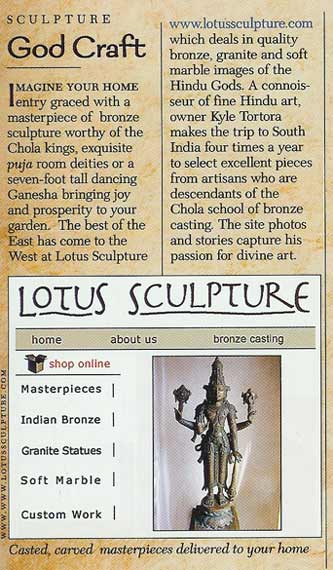 |  | | | A Meditating Parvati bronze sculpture of ours was showcased in the Spring 2011 edition of Luxe Interiors + Design Magazine. The magazine focuses on high end home decoration. It was our 2nd time Lotus Sculpture was featured. | Editorial in Bibi Magazine  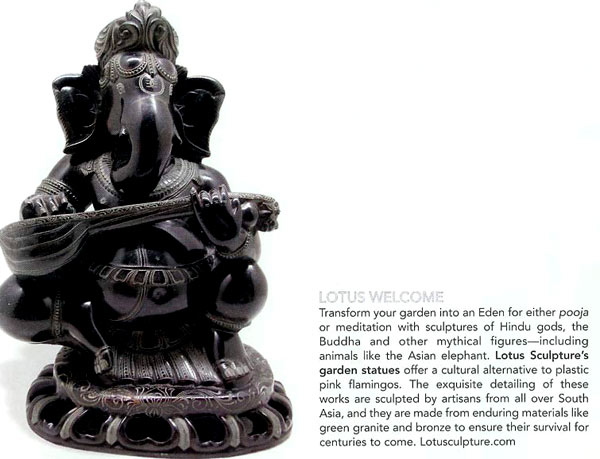 |
