My Cart: 0 item(s)

YOGA
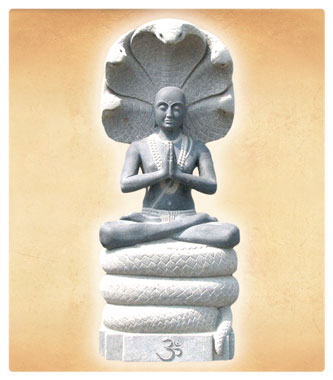
Yoga is a general term for spiritual disciplines that are directed toward attaining higher consciousness and liberation from ignorance, suffering, and rebirth. More specifically, yoga is also the name of one of the six orthodox systems of Hindu philosophy.
Both Vedic and Buddhist literature discuss the doctrines of wandering ascetics in ancient India who practiced various kinds of austerities and meditation.
The basic text of the Yoga philosophical school, the Yoga Sutras of Patanjali (2nd century B.C.) is a systematization of one of these older traditions. Contemporary systems of yoga, such as those of Sri Aurobindo Ghoso and Sri Chinmoy Ghose, stress that spiritual realization can be attained without the withdrawal from the world characteristic of the older traditions. Yoga is usually practiced under the guidance of a guru, or spiritual guide.
Patanjali divides the practice of yoga into eight stages. Yama, or restraint from vice, and niyama, or observance of purity and virtue, lay the moral foundation for practice, removing the disturbance of uncontrolled desires. Asana, or posture, and pranayama, or breath control, calm the physical body, while pratyahara, or withdrawal of the senses, detaches the mind from the external world. Internal control of consciousness is accomplished in the final three stages: dharana, or concentration, dhyana, or meditation, and samadhi.

Through such practices yogis acquire miraculous powers, which must ultimately be renounced to attain the highest state. In samadhi, the subject-object distinction and one's sense of an individual self disappear in a state usually described as one of supreme peace, bliss, and illumination. A common feature of different traditions of yoga is one-pointed concentration on a chosen object, whether a part of the body, the breath, a mantra, a diagram, a deity, or an idea.
Hindu tradition in general recognizes three main kinds of yoga: jnana yoga, the path of realization and wisdom, bhakti yoga, the path of love and devotion to a personal God, and karma yoga, the path of selfless action. Other classifications exist. Patanjali's yoga is known as raja, or "royal," yoga. Hatha yoga, which stresses physical control and postures, is widely practiced in the West.
Kundalini yoga, especially associated with Tantra, is based on the physiology of the "subtle body," according to which seven major centers of psychic energy, called chakras, are located along the spinal column, with the kundalini, or "coiled" energy in latent form, located at the base of the spine. When the kundalini is activated by yogic methods, it ascends the spine through the main subtle artery of the sushumna, "opening" each chakra in turn. When the kundalini reaches the topmost chakra in the brain, samadhi is attained.
View Lotus Sculpture Statues
