My Cart: 0 item(s)

Nataraja (old)
Nataraja - Lord of Dance
| | The most important and dramatically conceived of all the divine images of South Indian school are representations of Nataraja - Siva as the Lord of Dance - either in the playful or the destructive aspect. Siva is the Divine Dancer, visualized in terms of motion and vibration, who in 108 varied movements interprets the mathematical Law of the Universe.
| |
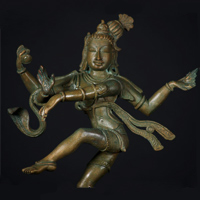
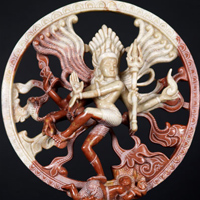
Dr. Ananada Coomaraswamy interprets Siva's cosmic dance in metaphysical terms : "In the Night of Brahma, Nature is inert, and cannot dance till Shiva wills it: He rises from his stillness, and, dancing, sends through matter pulsing waves of awakening sound, proceeding from the drum : then in the fullness of time, still dancing, He destroys all Names and Forms by Fire, and there is new rest. Thus Time and the Timeless are reconciled by the conception of phase alternations extending over vast areas of space and great tracts of time. The orderly dance of the spheres, the perpetual movement of atoms, evolution and involution, are conceptions that have at all times recurred to men's Minds : but to represent them in the visible form of Nataraja's Dance is a unique and magnificent achievement of the Indians.
| Siva's dance, the Nadanta, is to the Dravidian mind a personification of the cosmic forces of nature, the pulsation of electronic energy within the universe. In the Nadanta dance, Siva personifies the kinetic aspect of his divinity, the elemental force through the power of which the whole universe is created, sustained and ultimately destroyed. As Havell says, the image of Siva as Dhyani-Buddha is only the static center round which the forces of the cosmos revolve, as the electrons whirl round the static nucleus of the atom. He is the Supreme Intelligence, the Divine Spirit, Dancing the dance of Karma. "They never see rebirths who behold the mystic dance." In the words of Dr. Coomarasamy, " the Indian Nataraja may well be claimed as the clearest, most logical, and impassioned statement of the conception of life as an eternal Becoming." The Nataraja typifies the universe in the action of creation and destruction. "This is his dance in the last night of the world when the stars fall from their courses and all is reduced to ashes, to be ever rekindled, ever renewed by the boundless power of the Lord . . . The Dionysian frenzy of his whirling dance presents affirmation of the eternal, unseen spectacle of the dynamic disintegration and renewal, birth and death, of all cosmic matter in every second as in every kalpa of time. . . " | |
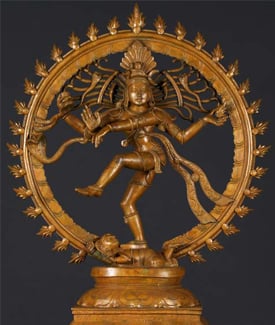
This mystical and metaphysical conception of Divine Ecstasy could not naturally be grasped by the ordinary mind and for them a popular mythological explanation was evolved. Once, Siva disguised as a simple ascetic, wandered into a hermitage deep in a dark forest, where his enemies, the heretical Rishis, priests, had assembled. He confuted all their attempts at argument and in revenge they tried to destroy him by the use of black magic. At first, they created a fierce tiger that sprang up on Lord Siva from the sacrificial fire. Siva stripped off the tiger's skin with his nails and wrapped it round his loins. Next, the Rishis created a venomous serpent. Only, Siva calmly took hold of it in his bare hands and placing it round his neck, began to dance. But the Rishis were not yet done. An ugly dwarf demon evolved out of the sacrificial fire, only to be crushed under Siva's feet, its back broken. And all the time, the triumphant whirlwind of the dance continued, as the assembled Rishis and Devas watched in awe and fear.