My Cart: 0 item(s)

Bronze Sculpture Cleaning & Care
How to Clean and Care for Bronze Sculptures
The most natural way to care for your Thai brass, south Indian and Bangladeshi bronze statues from Lotus Sculpture is to use a cotton cloth to wipe down the statue. This prevents dust build up. If you would like to make the statue shine use a rag with a natural oil, like olive oil. In India they use coconut oil. Natural oils will not chemically remove any of the original coloring of the piece. It returns the piece to it's most natural state. Although it is not recommended to entirely remove the green patina coloring, natural oils will succeed in removing some of the excess green coloring on bronze statues.
|
Bronze is copper alloy. It is generally more expensive than brass and more corrosion resistant. Bronze forms a patina (green color) which is protective to the metal and is often seen on artwork. The green patina is indicative of older pieces and is prized by collectors. Over time, bronze will deteriorate if exposed to moisture and chlorides or sulfides. Moisture alone will not damage bronze making bronze sculpture ideal for outdoor garden settings. Bronze is a metal. It is natural for metal to color in time. In our opinion a natural coloration gives a sculpture character and thus adds to the esthetic value of a piece. For a more thorough cleaning, carefully wash with a solution of 1 tablespoon of salt and 3 1/2 quarts of water. Rinse well. Polish with copper polish followed by glass wax. If you want a high polish, dip a cloth into liquid wax and apply to the piece. When dry, buff lightly to a high gloss. A wax treatment also may be given to bronze pieces that are kept outdoors. Weathered bronze usually darkens; however, this is natural and does not harm the piece. |
|
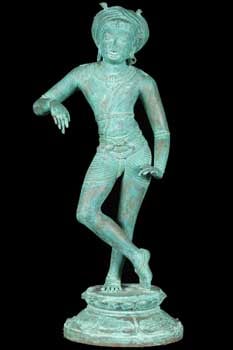
"Bronze disease" is one of the most serious hazards of bronze. This disease, caused when chlorides and oxygen combine in a damp environment, also attacks brass and pewter. The disease takes the form of a sudden outbreak of small patches of corrosion and is distinguished by rough, light green spots. "Bronze disease" usually can be stopped by going over the piece with a layer of natural oil. If this does not help the piece you may want to try washing the piece in repeated changes of boiling hot, distilled water. You may have to soak the object for a week or more in distilled water.
General Purpose Bronze Cleaner: Salt, Vinegar, and Flour. Dissolve 1teaspoon salt in 1 cup white vinegar. Add enough flour to make a paste. Apply paste to bronze and let sit for 15 minutes to 1 hour. Rinse with clean, warm water, and polish dry.
How to Clean and Preserve Polished Bronze Statues from Lotus Sculpture
by P. Throne. Mr Throne is a customer of Lotus Sculpture. He also is the founder of Project Ganesh, a non profit foundation that raises money for the restoration of Ganesh temples in India. Please take a look at
http://www.projectganesh.org for more information.
"1) Make a soupy paste of pure calcium carbonate (marble dust, available at art supply stores) and distilled water. Some people recommend a little ethyl alcohol in the paste, but I just used distilled water and it worked great.
2) Use a soft cloth to rub the bronze with the chalk paste. It takes off the dirt and oxidation (if desired), but does not bite the metal like a chemical polish would.
3) Rinse well in distilled water, using a soft brush to clean the paste out of crevices. Let dry.
4) Apply Renaissance Wax (museum quality archival wax, available through Woodcraft.com and other internet suppliers). Allow the wax to dry and then buff with a soft brush like a shoe polish brush.
The wax will prevent further oxidation. If a natural patina is desired, then the wax can be skipped. The wax is not a permanent protection, but it is long-lasting."
How to Clean Bronze - 2002 Consumer Reports
Clean with a soft brush. If you notice the surface is still dirty, sponge lightly with soapy water, wipe dry, and polish with a chamois cloth. Remove stubborn marks with a little paint thinner on a soft cloth, and polish with a chamois cloth.Helpful Hint
Save yourself some elbow grease: There's no need to keep outdoor ornament made of bronze squeaky clean and shiny. Bronze is intended to have a dull patina and usually doesn't look as attractive when it's polished to a high shine.