My Cart: 0 item(s)

Learn About Hindu Gods and Goddesses
Symbols & Meanings
Hindu Gods and Goddesses
Hinduism honors one supreme reality, Brahman, expressed through many divine forms. Meet the gods and goddesses you will find in Hindu art, and discover what each one represents.
 The DestroyerShivaOne of the most widely worshipped Hindu gods. Shiva destroys so that the universe can be renewed, holding the endless cycle of beginning and ending.Learn more →
 Remover of ObstaclesGaneshGod of wisdom and new beginnings. Ganesh is honored first, before any new venture, to clear the path of difficulties.Learn more →
 The PreserverVishnuOne of the principal deities of Hinduism and part of the Trimurti. Vishnu upholds dharma, the moral order of the universe.Learn more →
 Dancing Lord ShivaNatarajaShiva as the Lord of Dance. Every detail of his cosmic dance symbolizes the cycle of destruction, creation and rebirth.Learn more →
 Divine CowherdKrishnaOne of the most beloved of all Indian deities, worshipped as the eighth avatar of Vishnu and the voice of the Bhagavad Gita.Learn more →
 Benign Aspect of DeviParvatiThe gentle, nurturing form of the Divine Mother and consort of Shiva. Her name means “daughter of the mountain.”Learn more →
 Monkey GodHanumanCelebrated for courage, strength and selfless devotion as the faithful companion of Lord Rama.Learn more →
 Goddess of WealthLakshmiGoddess of wealth, good fortune, beauty and abundance, and consort of Vishnu. She is often shown seated on a lotus.Learn more →
 Goddess of WisdomSaraswatiGoddess of knowledge, music and the arts, the flowing river of consciousness that brings creation to life.Learn more →
 The UnconquerableDurgaThe radiant warrior form of Devi, created from the combined power of the gods to defeat the buffalo demon Mahishasura.Learn more →
 God of CreationBrahmaThe creator of the universe and one of the Trimurti, with Vishnu and Shiva. His consort is Saraswati.Learn more →
 Goddess of TimeKaliThe fierce goddess of time and change. In the Devi Mahatmya she defeats the demon Raktabija, whose every drop of blood spawned a new demon.Learn more →
 God of WarMuruganSon of Shiva and Parvati, also known as Skanda and Kartikeya, and especially beloved in Tamil Nadu and South India.Learn more →
 Feminine EnergyShaktiThe divine feminine power behind all creation. In the Shakta tradition, Devi is worshipped as the Mother of the World.Learn more →
 Father of YogaPatanjaliThe sage traditionally credited with compiling the Yoga Sutras, the foundational text of classical yoga.Learn more →
“There can really be as many Hindu gods as there are devotees, to suit the moods, feelings, emotions and social background of the devotees.”Attributed to Sri Ramakrishna
Understanding the Gods
One Truth, Many Forms
The pantheon of Hindu gods is vast and diverse, yet at its heart is a single ultimate reality: Brahman. Brahman permeates everything in the universe. It is impersonal and beyond description, transcending every form and attribute. Everything is part of Brahman, yet Brahman is more than the sum of its parts.
The many gods, such as Shiva, Vishnu and Brahma, are accessible expressions of this unknowable reality. They give devotees forms to see, touch and feel, so they can connect with the divine personally. Each one reveals a particular aspect of Brahman, making the infinite easier for the human mind to grasp.
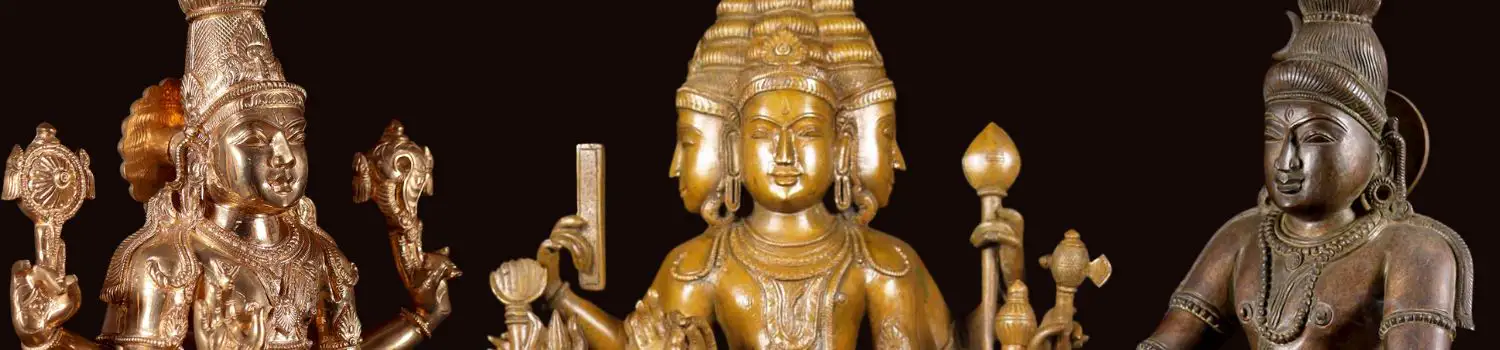
The Trimurti
Three gods embody the great cycle of the universe.
Brahma
The Creator
Brings all things into existence.
Vishnu
The Preserver
Maintains dharma and the cosmic order.
Shiva
The Destroyer
Dissolves the old so that transformation and rebirth can follow.
The Divine Feminine
Shakti: The Power of the Goddess
The goddesses are just as central to Hinduism as the gods. Together they express Shakti, the feminine divine energy that keeps the universe in balance. Parvati embodies love and devotion, Lakshmi brings prosperity and well-being, Saraswati inspires wisdom and the arts, and Kali represents time and transformation. As the Divine Mother, the goddess is both nurturing and fierce.
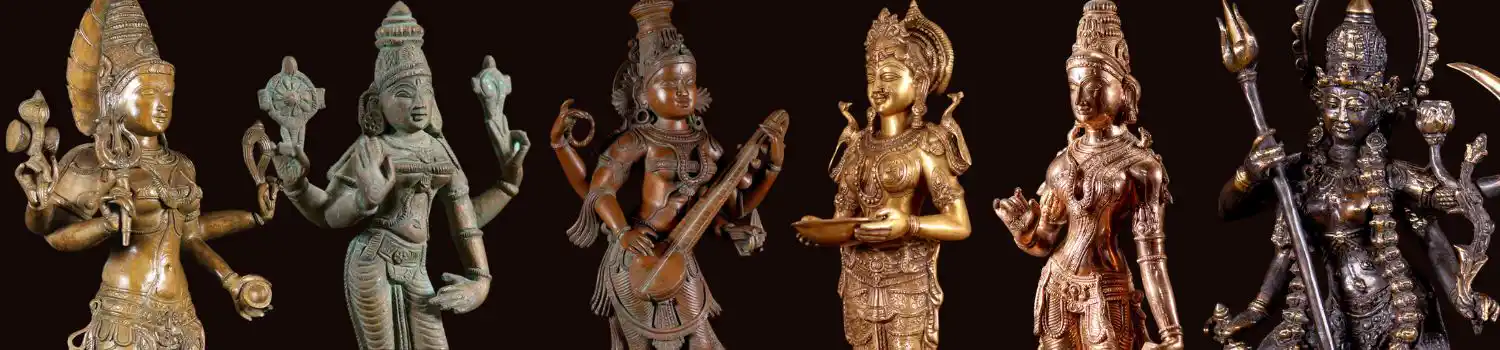
These goddesses are not simply consorts of the gods. They are powerful deities in their own right, each revered for her own qualities, reflecting the Hindu understanding of balance between masculine and feminine energy within the divine.
Questions
Common Questions
How many Hindu gods are there?
A traditional figure is “33 crore,” often translated as 330 million. Many scholars note that the Sanskrit word koti can also mean “type,” pointing to the 33 deities named in the Vedas. Either way, the idea is the same: the one divine reality can be worshipped in countless forms.
Do Hindus believe in one God or many?
Both, in a sense. Hindus worship many gods and goddesses, but most traditions understand them as expressions of one supreme reality, Brahman. A devotee may focus on a chosen deity while recognizing all of them as faces of the same divine.
Which Hindu god is right for my home?
Choose the deity whose qualities you want to invite. Ganesh is a favorite near the entrance or a new venture, Lakshmi for prosperity, Saraswati for a study or music room, and Shiva or Nataraja for a meditation or yoga space.
How should I place a Hindu statue?
Place it at or above eye level, never directly on the floor, in a clean and calm spot. Many people face the statue toward the room or the entrance and keep the area around it uncluttered.
Kyle Tortora, Founder