My Cart: 0 item(s)

The Pala Dynasty
|
|
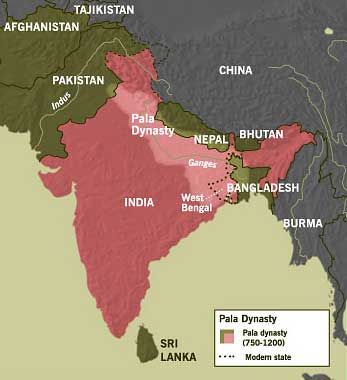
The Pala Dynasty was the ruling Dynasty in Bihar and Bengal India, from the 8th to the 12th century. Called the Palas because all their names ended in Pala, "protector". The Palas rescued Bengal from the chaos into which it had fallen after the death of Shashanka, a rival of Harsha of Kanauj. The founder of the dynasty was Gopala. Gopala reigned from 750-770 consolidated his position by extending his control over all Bengal. His successor. Dharmapala , 770-781, made the Palas a dominant power of northern India, installing his own nominee on the once-prestigious throne at Kanauj. but the Palas soon were threatened by the Pratiharas of central India and gained respite from attacks only because the of a threat to the Pratiharas from another foreign power, Rashtrakutas of the Deccan. Under Devapala, 810-850, the Palas were able to regain their eminence against both the Pratiharas and the Rashtrakutas. Devapala's successors were peaceful men, either by disposition or circumstance, and after 860 the Pala empire disintegrated. In addition to the depredations of their northern Indian rivals, the Pals also suffered an invasion by the Chola Rajendra I in 1023. Pala fortunes were revived briefly by Rampala 1077-1120, but by the middle of the 12th century the Pala kingdom had succumbed to the rising power of the Senas. The Palas, adherents to Mahayana Buddhism, were generous patrons of Buddhist temples and the famous universities of Nalanda and Vikramashila. It was through their missionaries that Buddhism was finally established in Tibet. The celebrated Buddhist monk Atisha 981-1054, who reformed Tibetan Buddhism, was the president of the Vikramashila monastery. the Palas also maintained cordial relations with the Hindu-Buddhist state of the Shailendras of Sumatra and Java. Under Pala patronage a distinctive school of art arose, of which many noteworthy sculptures in stone and metal survive.. |