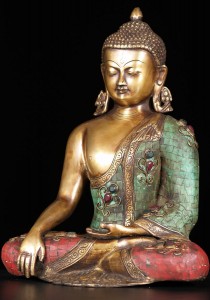
Have you ever thought about the fact that Buddha statues are never the same? Some have their hands lying quietly in their lap, some point to the earth, and some are lifted in a sign of comfort.
It’s not random. The hands of a Buddha figure, it may be a towering marble Buddha statue or a small brass Buddha statue for an altar, are the ones that are calling you. These characters communicate with each other through one silent language common to all which is Mudra, a Sanskrit term meaning “seal,” “gesture,” or “mark.”
If you want to be really familiar with the Buddha sculptures and also be able to purchase the right piece for your home or garden, you need to comprehend this deep language. Mudras are not simply the figures of the Buddha showing a certain way of the hand; they are the important symbolic lifelines of the Buddha’s life, the Buddha’s different levels of awareness, or the Buddha’s deep teaching. They are quick to communicate being wise, courageous, or calm.
This is your guide to the most holy and common Buddha mudras can be deciphered that you will find in Buddhist art.
The Language of the Hands: Why Mudras Matter
In the tradition of Buddhist art, each pose, each adornment, and each placement signify something profound. The mudra is, without a doubt, the most significant iconographic detail which essentially determines the entire objective of the work.
Choosing a Buddha statue as home decoration means that you are introducing a powerful energy into your place. When you pick a statue with a certain mudra, it is a calculated step to bring that feeling, whether it is peace, protection, or light, to your living space. Knowing the sign enables you to be certain that you are creating the right atmosphere at your altar or in your meditation room.
1. The Earth Witness Mudra (Bhumisparsha Mudra)
This may be the one and only most potent and most easily identifiable gesture among all the works of Buddhist art. It is the depiction of the instant of Buddha’s Enlightenment.
- What it looks like: The way to show this is through the left hand resting on lap, palm facing upward (meditation). The right hand stretched out toward the right knee with the fingers touching the earth or pointing to it.
- The meaning: It stands for the spiritual “showdown.” When Siddhartha was about to attain enlightenment, the demon Mara confronted him and asked who would be the witness of his right to reach such a state. Siddhartha didn’t argue but he just touched the earth. It is said that Earth Goddess herself came out to witness his innumerable lifetimes of virtue, thus, helping Siddhartha to overcome Mara’s temptation.
- The Energy: It is a very firm gesture. It signifies the triumph of the “higher self” over doubt, fear, and desire. It indicates that truth does not have to be shouted; it only has to be seen.
- Where to place it: A figure with this mudra is an absolutely clear figurative image of an altar or a quiet corner in the study, showing profound understanding and your indestructible inner power.

2. The Meditation Mudra (Dhyana Mudra)
Just think of a gesture that stands for absolute calmness and concentration – that would be it. If you are looking for a Buddha statue as a personal practice altar, then this is clearly the eternal choice.
- How it looks: The hands clasp the lap; both the palms are turned upwards, and the right hand is laid over the left one in a gentle manner. Often the thumbs are slightly touching thus forming a closed triangle or some kind of vessel.
- The meaning: This sign conveys the concentration and profound meditation that comes as a result of the quest for spiritual perfection. The container made by hands stands for the emptiness of the world and the unity of mind and body.
- The Energy: Serenity, unshakable focus, and inner harmony.
- Where to place it: Your main meditation room would be the perfect place, a bedroom, or any spot where you crave quiet and rest. A Buddha idol embodying this condition is extremely helpful in calming the mind and, therefore, it becomes a lot easier to concentrate for longer periods of time.

3. The Fearlessness Mudra (Abhaya Mudra)
Abhaya Mudra is a powerful and caring gesture, the one that brings safety and comfort. If you are looking for a Buddha statues for the garden or the gate, this mudra is mostly picked up for its clear and warm message.
- How it looks: The hand is raised to the shoulder with the palm facing away, the arm is bent. The left hand can be just hanging by the side or lying on the lap.
- The meaning: This is the “stop,” “fear not,” or “protection” sign. Buddha is said to have used it to quiet his assault on an elephant, thus, it stands for the power of the divine bringing peace and protection. It absorbs the fear and brings out the bravery.
- The Energy: Boldness, kindness, and the feeling of being protected are some of the attributes of the energy.
- Where to place it: Near the main door of your home or workplace, it is great in indicating a welcome to visitors and keeping negativity away.

4. The Teaching Mudra (Vitarka Mudra)
This is the gesture of a reasonable, intelligent, and knowledge-sharing discussion which also involves disputing the opposite view.
- How it looks: The arm is lifted with the palm outward. The thumb and forefinger are joined to make a circle. The remaining three fingers are sticking up.
- The meaning: The round shape made by the thumb and forefinger stands for the uninterrupted flow of intellect and the cycle of teachings, it refers to the universal law of Dharma which has no beginning or end. It is the communication of Dharma.
- The Energy: Clarity, teaching, and intellectual power.
- Where to place it: A study, library, or office would be the best place for it, anywhere learning and discussion are the main themes. Choosing Buddha home decor, let the mudra be your guide based on the vibe you wish to bring.

5. The Gift-Giving Mudra (Varada Mudra)
The Varada Mudra is a sign that shows the gesture of giving, loving-kindness and also the bestowing of desires.
- How it looks: Typically, the arm is stretched down with the hand turned a bit inward. The palm can be facing a little outward or forward, and the fingers are long and pointing downward.
- The meaning: This hand gesture stands for giving, welcoming, and being honest. It is an influential memory of the moral being generous and loving all creatures.
- The Energy: Giving, loving-kindness, and joy.
- Where to place it: This gesture is one of giving, welcoming, and being genuine. It is an impressive call to the moral attribute of giving and loving all living creatures.

Choosing the Right Mudra for Your Space
If you are going to buy a Buddha statue as part of your home decor, you may want to consider the mudra and figure out what type of energy you wish to create.
| Your Goal | Recommended Mudra | Why? |
| Cultivate Peace & Focus | Dhyana Mudra (Meditation) | Instills deep calm and concentration. |
| Require Strength & Truth | Bhumisparsha Mudra (Earth Witness) | Represents unwavering resolve and enlightenment. |
| Desire Protection & Safety | Abhaya Mudra (Fearlessness) | Dispels fear and offers reassurance. |
| Encourage Learning & Wisdom | Vitarka Mudra (Teaching) | Promotes clarity in thought and discourse. |
| Seek Compassion & Charity | Varada Mudra (Gift Giving) | A reminder of generosity and acceptance. |
Mudras and Materials: The Final Seal
Whatever it is that you might have picked out: a nice durable bronze Buddha statue for the garden, or an intricately detailed wood carving for the shelf – most of the time, it is the material that decides the completion of the mudra:
- Brass/Bronze: The two metals are regularly seen in the figures of Bhumisparcha and Abhaya mudras, and the metals symbolize strength and power as well as longevity.
- Wood/Stone: Perfect for Dhyana mudras in meditation halls, these materials have the ability to create a natural, earthy atmosphere.
Mudras are essentially human truths and a spiritual path presented in a very simple and elegant way. Their amazing power lies in their ability to transcend language and communicate these truths not only to the present but also beyond.
Knowing these hand positions your statue is no longer just an ornamental item but a spiritual anchor of great depth, resonating with the energy you require most.
Take a look at all of our Buddha statues Collection and decide on the mudra that fits best with your spiritual place.
