Saraswati Statues for Home Mandirs, Study & Music Rooms: Buying Guide

saraswati statue

Have you ever noticed how some spaces naturally make you feel calm, focused, and inspired?

Maybe it’s a quiet study where ideas seem to flow effortlessly. A music room where every note feels meaningful, or a peaceful home mandir that instantly brings your mind to stillness.

If there’s one deity who beautifully belongs in these spaces, it’s Goddess Saraswati, the embodiment of wisdom, learning, music, creativity, and graceful speech. Bringing home a Saraswati statue isn’t just about decorating a shelf or filling an empty corner. It’s about creating a space that reminds you and everyone in your family to keep learning, stay curious, and approach life with clarity.

But with so many beautiful Saraswati murtis available in marble, bronze, brass, and wood, how do you know which one is right for your home?

Let’s explore.

Before You Buy, Take a Moment to Notice the Details

The first thing most people notice is Saraswati’s serene expression. Then comes the graceful veena, the elegant swan, the lotus beneath her, and the sacred book resting in her hand. But each of these details tells a story. When you understand these symbols, choosing the right statue becomes much more meaningful than simply selecting a decorative object.

The Veena– It represents music, harmony, and the balance between knowledge and creativity. It reminds us that true learning isn’t only intellectual; it also nurtures the soul.

The Lotus– Saraswati is often seated upon a lotus flower, symbolizing purity, wisdom, and spiritual growth. Like the lotus that blooms untouched by muddy waters, wisdom remains pure despite worldly distractions.

The Swan (Hamsa)- The swan represents viveka, the ability to distinguish truth from illusion and make wise decisions. It’s one of Saraswati’s most recognizable companions.

The Sacred Book– The book symbolizes accumulated knowledge, education, sacred scriptures, and lifelong learning.

White Clothing– Goddess Saraswati is traditionally dressed in white, representing purity, clarity, and freedom from ego.

saraswati sculpture
Saraswati Statues

What Size Saraswati Statue Should You Choose?

Bigger isn’t always better. A statue should feel balanced within the room, not overwhelming, and certainly not lost in the space.

Think about how you’ll experience it every day.

For a study desk, a smaller statue between 6 and 12 inches feels personal and inspiring without taking over your workspace.

For a home mandir, most families find that 12 to 24 inches creates the perfect devotional presence.

If you’re designing a dedicated music room or creative studio, don’t be afraid to go larger. An 18-inch or taller bronze or wooden Saraswati statue can become the heart of the room.

saraswati statue
Bronze Saraswati Statue

Which Material Feels Right for Your Space?

One question almost every buyer asks is, “Which material should I choose?”

The answer isn’t about which one is better; it’s about which one feels right for your space.

A white marble Saraswati statue is a timeless choice for home mandirs and meditation rooms, reflecting purity, wisdom, and peace.

If music and creativity are at the heart of your home, a bronze Saraswati statue brings warmth, intricate craftsmanship, and a beautiful traditional presence to your space.

Looking for something perfect for everyday worship? A brass Saraswati idol is durable, easy to maintain, and ideal for daily puja on a home altar or in a study corner.

Prefer natural, earthy interiors? A hand-carved wooden Saraswati statue adds warmth and character to libraries, reading nooks, and creative studios.

Ultimately, choose the material that not only complements your décor but also feels meaningful every time you see it.

goddess saraswati statue
Wood Saraswati Statue

Where Should You Place a Saraswati Statue?

This is another question many people ask and for good reason.

According to Vastu Shastra, the northeast direction is considered the ideal location because it’s associated with wisdom, learning, and spiritual growth.

But placement is about more than directions.

Choose a clean, peaceful spot where the statue naturally belongs.

Avoid placing it directly on the floor. A small platform, shelf, or altar creates a respectful setting.

If possible, keep the area free from clutter. After all, a space dedicated to learning and creativity should feel calm, not crowded.

A Saraswati Statue Makes a Gift That Lasts a Lifetime

Some gifts are enjoyed for a few weeks; others become part of someone’s everyday life.

A Saraswati statue belongs in the second category. It’s especially meaningful during Vasant Panchami, Diwali, housewarming ceremonies, and graduation celebrations, when new beginnings naturally invite blessings of wisdom and creativity.

It’s a thoughtful gift for:

  • A student beginning college
  • A child preparing for exams
  • A musician opening a new studio
  • A teacher starting a new chapter
  • A writer searching for inspiration
  • A family celebrating a new home
saraswati statue
Browse Our Saraswati Statues Collection

Choosing the Right Saraswati Statue Is About More Than Beauty 

So when you think about what you’re actually after in a Saraswati statue, it’s not just “pretty” or “traditional”; it’s that mix of craft quality, material suitability and then the overall scale that really matches the specific corner and the person it’s meant for. In Lotus Sculpture’s Saraswati statue collection you’ll find handcrafted pieces that come in bronze, marble, brass and even wood, made by experienced artisans who still use traditional ways like lost-wax casting, plus you get a variety of sizes and design approaches, from classic South Indian forms to newer, more contemporary takes.

And honestly when you’re picking one, whether it’s for a home mandir, a student’s desk, a music room, or you’re buying it as a Saraswati statue gift for someone whose daily work is basically in the world of learning, knowledge and creative flow, the “right” statue is the one that sits well with the room, the personality, and the whole occasion it’s going to.

Hindu Goddess Saraswati: Goddess of Knowledge

“May Goddess Saraswati, who is fair like the jasmine-colored moon, and whose pure white garland is like frosty dew drops, who is adorned in radiant white attire, on whose beautiful arm rests the veena, and whose throne is a white lotus, who is surrounded and respected by the Gods, protect me. May you fully remove my lethargy, sluggishness, and ignorance.”

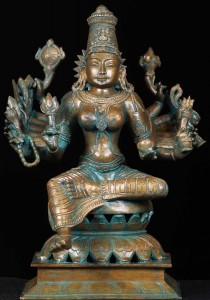
Within Hinduism, Saraswati is the Goddess of knowledge, art, music, and science. Companion to Brahma, it is said that Saraswati was key to his creation of the Universe.  As his source of vital spirit and energy, she along with Goddess Kali and Lakshmi played pivotal roles in helping the gods shape and maintain the universe.  Saraswati also plays an important role in Buddhism as sacred devotee of Gautama Buddha making sure his teachings live on in practice.   She is daughter to Durga and sister to Ganesh.
Click here to view all our Saraswati Statues

Saraswati is thought to contain the divine flow of all things serving as a beautiful body of knowledge and catalyst of learning throughout the world.  Her sultry appearance is striking and the epitome of feminine and divine beauty.  Her beauty is strategic in order to make knowledge and learning alluring to onlookers.  She is often depicted in flowing white to symbolize her purity and unmatched mind while seated upon a lotus flower which represents the light in knowledge.  By worshiping Saraswati one is able to realize the possibility of infinite knowledge and an endless quest of enrichment.  She embodies not only knowledge itself, but the highest of spiritual knowledge, much like Buddhist teaching of the Gautama Buddha reaching enlightenment.  Her potential is fully realized and as one follows her example they too can become enlightened.

Many devotees believe strongly in offering honey to goddess Saraswati during worship as a symbol of the purest of knowledge.

Click to learn more about Hindu goddess Saraswati.