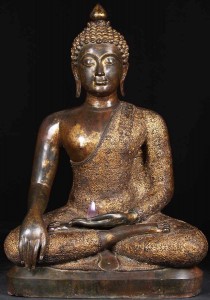
Buddha Statues for Meditation Space

Imagine converting a peaceful corner of your house into a personal retreat. Setting up a meditation room is the beginning of having a little more calm within. It’s where you can simply just leave the world behind and be you. A Buddha statue for a meditation room can be the ideal centrepiece in this room of yours—a soft nudge to breathe in and become acquainted with yourself.

We at Lotus Sculpture understand just how much each element matters. Just as a lotus blooms wonderfully out of the mud, Buddha statues represent a sort of peace everywhere. The correct statue can truly establish a peaceful mood for practice. But with so many types of statues out there, how do you choose the one that’s appropriate for you?

The Language of Peace: Understanding Buddha Postures and Their Meanings

Have you ever looked at Buddha statues in various positions and asked yourself what they are about? Not only is the beauty of these statues in their serene faces, but also in their varying positions, or mudras. Each position sends a varying message and can impart varying energy to your meditation space. Focusing on such subtle details can help you choose a statue that resonates with you and your way.

  • Dhyana Mudra (meditation position) is probably the most widely used. The Buddha sits in the lap with his hands, palms facing upwards, one over one. It represents concentrated efforts, calmness, and the achievement of inner peace. It is a strong figure of interior peace and is widely practised by those who want to introduce more calmness into their meditation.

“Peace is found inside. Don’t look for it outside.” – Buddha

  • The fearless position (Abhaya Mudra): Here you can see the Buddha lifting the right hand, facing the palm and indicating fingers. His left hand usually stays on the lap or hangs relaxed. This stance represents protection, bravery, and eradication of unpleasant emotions. Having an Abhaya Mudra Buddha at home may render you and your household protected and fearless on your spiritual path.
  • The Earth Touching Pose (Bhumisparsha Mudra): In this pose, Buddha extends his right hand to touch the earth and retains his left in his lap. This is the place where Buddha invoked the Earth to be witness to his awakening at the Bodhi tree. It’s a strong symbolic expression of having strong will and resisting temptation. This Buddha meditation statue is such a good reminder for maintaining tight in challenges in your own practice. 

Fact: According to Buddhist legend, Buddha sat under the Bodhi tree for 49 days before attaining enlightenment.

meditating buddha statue
Brass Buddha Meditating Statue

Choosing the Right Material for Your Sacred Space

Apart from the posture, the size and material of your statue also contribute towards establishing the mood for your meditation room. Lotus Sculpture has a vast collection of hand-painted statues in brass, bronze, and stone with each statue having its own personality and energy.

  • Stone and Marble Buddha Statue: A stone statue or a marble Buddha figure introduces a quality of grounding and stability. These are cooling and soothing energies and can also act as a very strong anchor for your altar. The serenity and simplicity of a stone statue have the ability to enhance the serenity of a peaceful meditation room.
  • Brass and Bronze Buddha Statue: These are warm, vintage sophisticated metals.  They are highly detailed and may create a strikingly aged appearance over time. A small brass or bronze Buddha statue is a humble but beautiful finishing touch to a tabletop altar.
  • Wood Buddha Statue: A Buddha statue made of wood releases a natural, cosy ambience and is perfect for producing an earthy, cosy meditation room. It is an easy material to carve intricate details, and each one has a special grain and texture.

Remember to include size. A statue that is too large may be overwhelming in a small area, but one that is too small may get lost in a large area. The secret is finding a size that is just right.

meditating buddha statue
Earth Touching Mudra Buddha Statue

Integrating Your Statue into Your Meditation Space

So, you’ve picked the perfect Buddha statue. How do you place it to make your meditation area feel peaceful and welcoming?

  • Placement: Hold the statue somewhere when you can easily see it while meditating. It can be on a shelf, an altar or a low table. Organize the place where your statue is not chaotic, but clean so you can easily focus.
  • Accessories: You can put other important objects near your statue like candles, incense, or a water bowl. Your own personal belongings are what can further personalize your space and practice.

Statistically, a point of reference when meditating can calm the mind and enhance concentration. Research in the Mindfulness journal would imply that a clean visual point of reference can guide practitioners on their way, and thus, a statue becomes not just a religious but also a useful resource.

Finding Your Perfect Buddha at Lotus Sculpture

We here at Lotus Sculpture are committed to bringing the serenity and beauty of Buddhist sculpture into your living space. Our statues are lovingly handmade by skilled artists who take great care in their work. A good Buddha statue for a meditation room can be a potent inspirer and stunning addition to your practice.

No matter if you’re attracted to the deeply meditative Dhyana Mudra, the defensive Abhaya Mudra, or one of the other sacred poses, we encourage you to browse our collection and discover the Buddha statue that speaks to your soul and brings your meditation room to a true sanctuary of peace.

meditating buddha statue
Meditating Buddha Statue

Postures of the Buddha

Large_Chiang_Saen_Buddha_Statue
View all Buddha Statues from Lotus Sculpture

The Buddha is often depicted within art and sculpture holding many different poses or postures.  A lot of times these poses include specific hand gestures as well as positioning of the legs.  Many people wonder the meanings behind these certain hand gestures and seated positions.  The Buddha is often seen with either his ankles tucked, called the Double Lotus position, or with one leg resting atop the other which is called a Single Lotus position.  These seated positions are in combination with certain hand gestures called Mudras.

One such posture that is commonly seen is the Buddha sitting with crossed legs (Double Lotus) and both hands resting palms up upon his knees.  This stance represents meditation and is the most common posture due to the Buddha’s enlightenment through meditation underneath the Bodhi Tree.  This stance, called the Meditation Buddha, represents inner wisdom, emotional stability, and clarity of the mind.

Another important posture is that of the Buddha with legs crossed (Double Lotus), left hand resting face up within his lap, and right hand pointing to the ground with his palm facing towards him.  This pose is regarded as the Buddha calling the earth as witness to the moment he reached enlightenment.  This stance, called the Enlightenment Buddha, signifies gaining insight, achieving great character, and having self-discipline.

Here are a few more common postures of the Buddha:

Protection Buddha: The Buddha sits in either Double or Single Lotus position with right hand raised facing outward and left hand in the lap.  This position represents having courage and offers the bearer protection against fear, delusion, and anger.
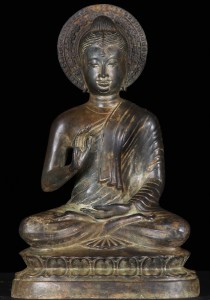
Teaching_Budda
Teaching Buddha Statue

Teaching Buddha: The Buddha sits in a Double Lotus position with hands up at chest level.  His hands form a circle by joining thumbs and index fingers with the right palm facing in and the left facing out.  This position brings about wisdom, understanding, and finding the truth behind your life’s path.

Contemplation Buddha:  The Buddha stands with legs together and both arms against the chest, palms in, and right hand on top of the right.    This pose represents patient understanding.

View all Buddha Statues from Lotus Sculpture