Best Spiritual Statues for Meditation Rooms

Thai brass buddha statue

As you enter the room, you may feel an instant sense of being “calm”. In our world today, which is very fast-paced and always on, more Americans are creating areas in their homes for silence, where they can spend a moment alone, whether it is an unused guest room, quiet corner or converted coat closet. A meditation room gives you an area to “reset” yourself.

How to create a sacred space is often just a matter of focal points, visual anchors that represent/embody the qualities you wish to try to acquire for your own practice. Choosing one of the right pieces of spiritual art for your home will give you a place to put your focus and provide your eyes with a place to relax. Additionally, these visual anchors may help you develop the qualities you so desire, such as peace, strength, compassion, etc., by emulating what you see in them. The visual anchor or focal point that you select for your meditation practice will be based on what you are drawn to, whether it’s a sculpture of Buddha or a powerful sculpture of an important Hindu god, which can change the energy in the house you have selected as a sacred place.

This article will explain statues that will raise the vibration of your meditation space, from the peacefulness of Krishna statues to the fierce protective energy of a Durga statue.

buddha statue for home decor
Meditating Buddha Statue

Why Use a Statue in Your Meditation Space?

The purpose of meditation for most people involves performing self-examination. The question arises about why we require an external source of assistance. The spiritual statue functions as a “visual mantra” which people can use to achieve their spiritual goals. You can use a Ganesh statue and a Lakshmi sculpture to maintain your concentration on the particular energy that you aim to bring into your existence. The ancient practices of Vastu and Feng Shui prescribe specific methods for figure placement, which enable energy streams to move through space, leading to an easier process of achieving meditative states.

When you buy a premium product from an exclusive gallery space, your purchase goes beyond decoration because it delivers a hand-built tradition of artistic commitment that you can display in your living space. The marble Durga statue and the brass Durga statue both emit their respective artistic forms, which create specific sound frequencies that induce your mind to enter a state of complete relaxation.

Finding Your Focus: Which Deity Speaks to You?

The different spiritual figures display unique “vibes” which people observe. The different figures will connect with you better according to your current life needs, which include overcoming obstacles, finding inner peace or seeking wisdom. 

1. The Power of the Divine Mother: Durga

Meditation serves two different purposes because it helps people achieve “calmness” and discover their inner strength. The Durga sculpture fulfils this purpose. The Divine Mother exists in Durga, who embodies the sacred female energy known as “Shakti.”

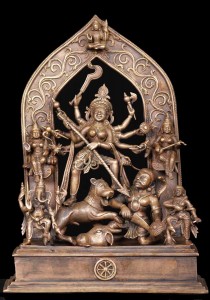
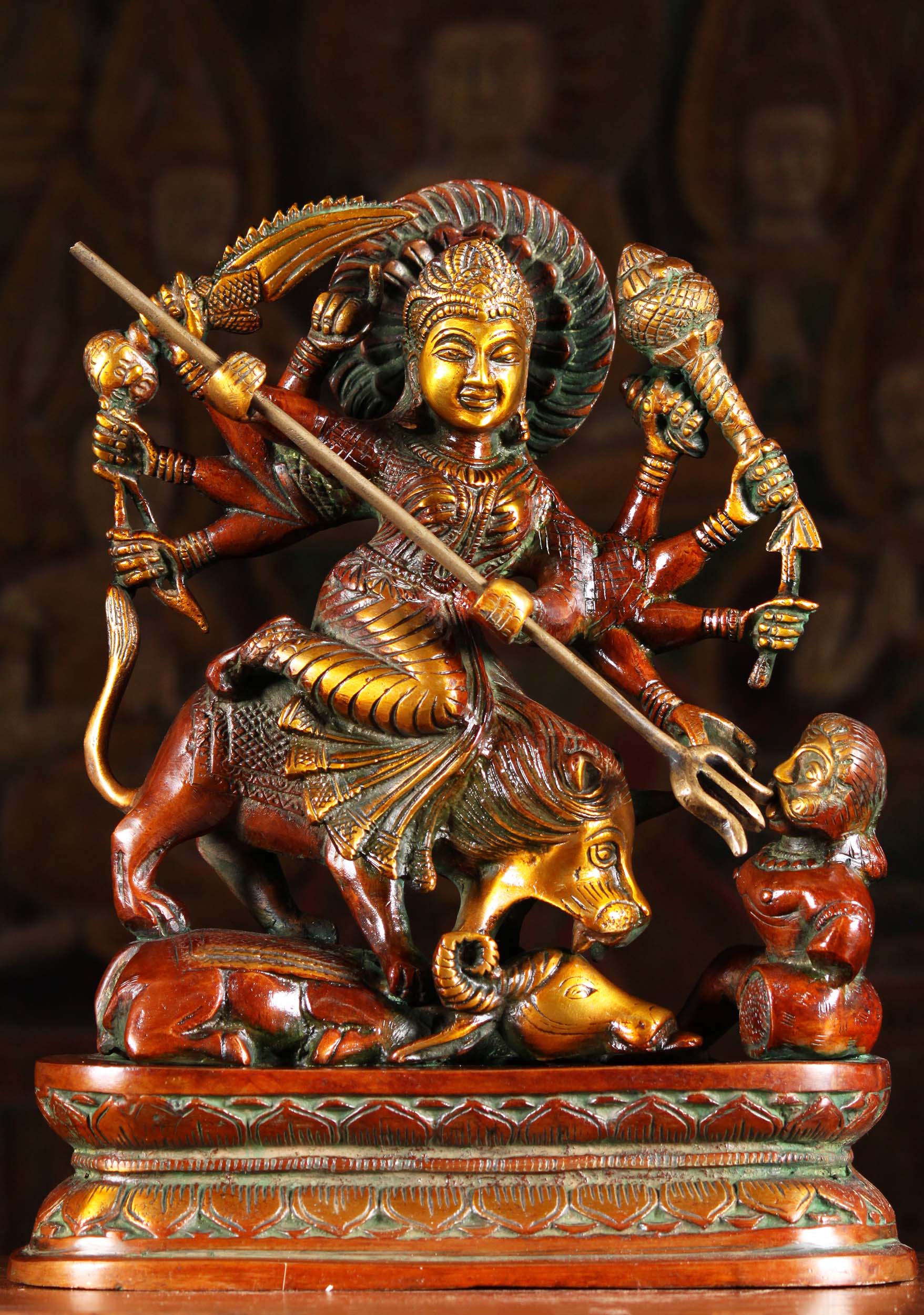
  • A Durga statue for home decoration brings spiritual value while its beautiful design creates an impressive visual presence, which demands respect and brings people a feeling of protection. 
  • People who use meditation for spiritual purposes should position a Durga idol at their meditation altar because its placement at the altar centre creates “fierce protection” which enables them to experience safety during their most defenseless moments of meditation.
Durga Statue
Durga Statue

2. The Path to Peace: Buddha Variations

The Buddha exists as the worldwide representation of enlightenment, while various artistic styles create distinct energetic expressions.

  • Thai Buddha Statues: These statues display slender, graceful features, which include a high ushnisha that resembles a flame to create an atmosphere of royal elegance within any space.
  • Indian Buddha Statues: The statues display traditional curly hair styling while their meditative postures show deep connections to historical traditions. 
  • Wood Buddha Statues: The material creates an authentic organic atmosphere through its natural wood grain, which brings an “earthy” quality to your practice. 
  • Fat & Happy Buddhas: Known as Budai, these statues create a joyful atmosphere that brings prosperity and carefree energy into your room.
buddha statue for meditation
Buddha Statue

3. Wisdom and Art: Saraswati & Krishna

Your meditation practice needs Saraswati statues because it functions as a creative endeavour. The goddess of knowledge, music and arts presents her presence to create inspiration streams. The Krishna statues show people divine love together with joyful happiness. The sight of Krishna, who plays the flute in a playful position, brings your morning routine happiness while it helps you to eliminate stress. 

krishna statue
Krishna Statues

4. Transformation and Compassion: Shiva, Tara, & Kwan Yin

Shiva statues serve as the ego-destroying force that enables deep transformational progress through their sculptures. The practice of mercy and compassion is best served through the use of Kwan Yin and Tara statues. The female figures function as the “Mother of Liberation”, who possesses the power to hear all human distress. The Avalokiteshvara statue shows Bodhisattva’s infinite compassion, which serves as a strong reminder to treat yourself and others with kindness.

shiv statues
Shiva Statues For Meditation Room


Choosing the Right Material for Your Vibe

The material of your statue affects both its visual appearance and the way it makes people experience the weight and spatial dimensions of the room. 

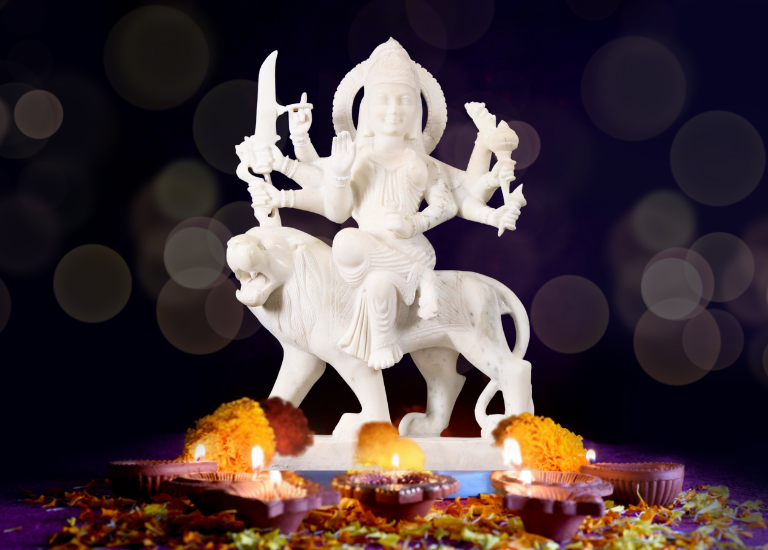
  • Marble Masterpieces: A marble Durga statue or marble Buddha statues offer a sense of purity and coolness. The hand-carved marble surface displays a white finish that provides exceptional elegance and peacefulness that suits a meditation space designed with high-end minimalist style.
  • Timeless Brass: The brass Durga statue has a golden appearance that radiates warm light. Brass stands as a long-lasting material that creates an attractive patina through its aging process, which transforms the item into a heritage object for your family altar.
  • Stone and Nature: If you want to create an organic atmosphere for your indoor space, hand-carved stone serves as the best choice to achieve a “Zen garden” ambience.

You can examine the materials by visiting the Durga Statues Collection or searching through the entire Hindu God Statues collection until you find the statue that speaks to you.

Bringing Spirit to the Outdoors

The best zen moments that you experience should lead you to practice your meditation outside. A Durga statue for an outdoor space can turn a simple backyard into a contemplative sanctuary.

  • Garden Buddha Statues: These statues are built to resist all weather conditions while they create an everlasting reminder for people to practice breathing.
  • Durga Statue for Garden: A large stone or bronze Durga statue, which people place in their garden areas, shows both natural strength and home protection.

The installation of a Durga statue for garden use serves two functions: it creates a decorative element and establishes a peace “portal” for your space. The garden altar, which you pass by throughout the day and which you view from your window, serves as a daily reminder to help you find your inner balance.

How to Set Up Your Sacred Altar?

The selection of your statue requires you to decide between three options, which include an Avalokiteshvara statue, a Ganesh statue, and a Durga idol. The majority of traditions recommend that people should position their primary statue at eye level, which matches their sitting cross-legged position. This position enables you to keep your head in a neutral position while you maintain a relaxed yet concentrated gaze.

  1. The Centerpiece: The main figure needs to be positioned directly at the center of the space. 
  2. The Elements: The statue needs to be surrounded by fire elements, which include a candle, a small bowl of water and incense for air and a crystal or plant for earth elements. 
  3. The Intention: You should approach the cleaning process of your Durga statue, which you use for your altars, with purposeful intention. Your meditation practice should include cleaning activities.

Conclusion: A Lifelong Companion

The proper statue for a meditation room does not exist because all statues present equal value. The Fat & Happy Buddha statue gives one person comfort, while the marble Durga statue provides another person with a sense of power.

The most important thing is that the figure speaks to you. The moment you discover a piece that resonates with you is the moment you establish a permanent relationship with your spiritual path through the brass Durga statue and Tara statue, which both feature distinct artistic designs. The items serve as physical objects while they function as reminders that you already possess inner peace and strength.

Your home should start to become your sanctuary after you set your intentions and select your anchor point.

Navaratri 2025- Significance of 9 Days of Navaratri

durga statue

Navaratri, is the most sacred Hindu festival on the calendar. It’s a colorful celebration of the divine feminine principle, or Shakti, and good triumphing over evil. Believers worldwide worship Goddess Durga in her nine forms for nine nights and ten days. The festival is a period of greater spiritual self-awareness, discipline, and group solidarity resulting in celebratory victory in Vijayadashami.

This year, Navaratri will be from Monday, 22 September 2025, to Wednesday, 1 October 2025, and Vijayadashami on 2 October. Each of these nine days celebrates a different quality of the goddess, mapping a gripping narrative of power, innocence, and final victory. This is a guide to each of these nine holy days.

The First Three Nights: Honoring the Warrior Goddess Durga

The first three evenings are all in honor of Goddess Durga since she represents strength, power, and courage. They are evenings to call upon us to overcome our own weaknesses and set us up for the spiritual journey before us. The goddess in her fiery form is invoked to destroy evil qualities and cleanse the mind. The spiritual energy of a lovely Durga statue as part of home furnishings can be a reminder of this power.

durga statues
Explore Goddess Durga Statues

Day 1: Goddess Shailaputri

Goddess Shailaputri, the “Daughter of the Mountain,” is the focus of the first day. She is the daughter of Himavan, the embodiment of the Himalayas, and thus the embodiment of the simple power of nature and the beginning of a new religious path. She rides a bull, carrying a trident and a lotus. Her worship is a beginning as she symbolizes the start of the festival and the divine power that pushes us ahead. Keeping a calm Shailaputri statue in your house can bring beginnings.

Day 2: Goddess Brahmacharini

The second day is devoted to Goddess Brahmacharini, the devotion and penance goddess. Her name is “one who practices Brahmacharya,” or spiritual discipline. She is shown walking barefoot, carrying a rosary and a water pot. Her physicality is a lesson that through patience, will power, and self-control, we can surmount anything. She is the ultimate symbol of self-control and patience, which are required to attain any spiritual heights. A stunning Brahmacharini idol can bring concentration and discipline to your life.

Day 3: Goddess Chandraghanta

The third day devoted to Goddess Chandraghanta, the married form of Parvati. She has been named thus because she wears half-moon bell (chandra-ghanta) on her forehead. She is a terrifying person of valour and tranquility, ready to fight against evil and yet showering tranquility on her devotees. Ten arms of hers carry various weapons, but she remains peaceful and elegant. Offering a puja to her grants courage and good sense of mind to a person. The strength and serenity of Durga statues perfectly embody this lovely combination of strength and peace, and therefore any Durga sculpture can be a good addition to a household. You can also find a rare Chandraghanta idol that offers worship on this day.

The Next Three Nights: Celebrating Abundance and Motherhood

The next three nights are spent in honor of Goddess Lakshmi, the goddess of prosperity, wealth, and spiritual richness. This is the section of the festival where requests are placed for the invocation of good energies and blessings for a peaceful and joyful existence. A peaceful white marble Durga statue would typically be the preference for this section of the celebration.

lakshmi & saraswati statues
Explore Goddess Lakshmi Statues

Day 4: Goddess Kushmanda

We pay our respects to Goddess Kushmanda on the fourth day. She is the creator of the world, having created the world with her pleasant smile. She has eight arms, which are filled with various objects representing her creative power and dominance over the world. Worship in her name is said to attain good health, wealth, and happiness. She reminds one of plenty and the abundance of opportunities in the world. A colorful Kushmanda idol can occupy your space with creative energy.

Day 5: Goddess Skandamata

The fifth is to Goddess Skandamata, mother of Lord Skanda (Kartikeya), war lord. She embodies the virtues of maternal love and compassion. Her benevolent form is depicted with her son on her lap. She is also worshiped to bring peace and wisdom, and is revered as the world mother. The day is more important for mothers, as they pray to her for good wishes for the health of their child. A serene Skandamata statue is a beautiful symbol of motherhood.

Day 6: Goddess Katyayani

Goddess Katyayani, who is a ferocious war manifestation of Durga created by the collective fury of the gods to defeat the demon Mahishasura, is the goddess of the sixth day. She is seated upon a lion and represents absolute power and willingness to engage in battle to right what is wrong. She is the power that destroys evil and makes righteousness the conqueror. A grand durga statue for outdoor space can represent this strong presence, and a beautiful Katyayani statue can also represent her fearlessness.

The Final Three Nights: Embracing Wisdom and Spiritual Fulfillment

The last three nights are dedicated to Goddess Saraswati,the goddess of knowledge, wisdom, and spiritual consciousness. The latter half of the festival is all about spiritual wisdom and celebrating the strength of inner consciousness. A sophisticated brass Durga sculpture can echo this refined subtlety.

Day 7: Goddess Kalaratri

The seventh night is all about Goddess Kalaratri, the most violent and frightful form of Durga. Her name is “the one who is the death of time.” She is the destroyer of ignorance, darkness, and evil spirits. Her appearance may be horrendous, but she is most dearly protective of her devotees. She is connected with the raw energy of transformation. Her intense form is inextricably linked to Goddess Kali, and worshipping her makes an individual transcend all kinds of fear and instill inner strength. The energy of a Kali statue for the altar wonderfully captures this aspect of the divine. You may also request a special Kalaratri idol to keep at home.

kali statues
Explore Goddess Kali Statues

Day 8: Goddess Mahagauri

We worship Goddess Mahagauri, the goddess of peace and innocence, on the eighth day. Her complexion was darkened after she did very heavy penance, but Lord Shiva cleansed her in the Ganga River and her complexion became fair again. She is peaceful, forgiving, and gentle. Her worship cleanses a devotee’s life and makes it beautiful and peaceful. Kanya Puja can be done today when little girls are worshiped as forms of the goddess herself. A serene figure of Mahagauri is a stunning embodiment of such purity.

Day 9: Goddess Siddhidatri

The ninth and last day is for Goddess Siddhidatri, the giver of supernatural power and spiritual wisdom. She is said to bestow all types of success and knowledge upon her followers. She sits on a lotus and holds a mace, discus, conch shell, and lotus in her hands. Her worship on this day brings the spiritual practice of Navaratri to its culmination in the best possible way since she fulfills all desires and grants all wishes. She is the epitome of spiritual practice and devotion. A beautiful Durga idol is generally a center of attraction on this last day, and throughout the year, a Siddhidatri idol can bless your house with flowers.

The Meaning of Navaratri

Navaratri is not merely a ritual festival. It is a tremendous call to action that we have to bridge to our own individual triumph, and it is from spiritual self-control and impartial heart that we derive power. The festival marks passing through the state of sanctity (Durga), to the state of prosperity (Lakshmi), to enlightenment (Saraswati). It is one of joy and uniting as a community in worship. It reminds us that divine feminine is a source of wisdom, power, and creation. That is why having a physical presence, such as a sacred Durga statue, can be such a vital part of one’s daily life.

Vijayadashami/ Dussehra: Celebrating the Victory of Good Over Evil

durga maa

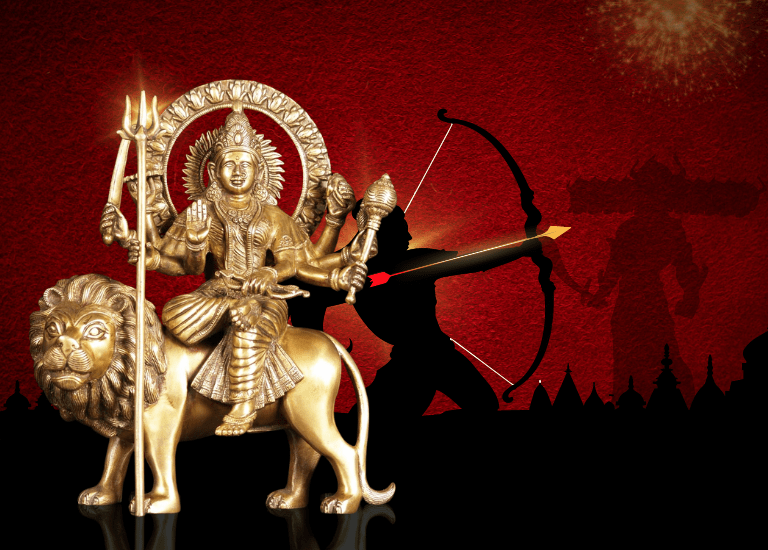
Vijayadashami, also known as Dussehra, is a significant Hindu festival that symbolizes the victory of good over evil. It is celebrated with great fervor across India and marks the culmination of two intertwined stories – the tale of Lord Rama’s triumph over the demon king Ravana and the story of Goddess Durga’s victory over the demon Mahishasura. Together, these stories remind us of the eternal struggle between good and evil, and the ultimate triumph of righteousness.

The Story of Lord Rama and Ravana

At the heart of Dussehra is the ancient story of Lord Rama, the seventh avatar of Lord Vishnu, who embarks on a quest to rescue his wife, Sita, from the demon king Ravana. Ravana, the ten-headed ruler of Lanka, kidnaps Sita, leading to an epic battle between the forces of good, led by Lord Rama, and the forces of evil, led by Ravana.

Rama is not alone in his quest. His loyal brother Lakshman and the devoted Hanuman, along with an army of monkeys, join him in the battle to defeat Ravana. After a fierce struggle, Rama finally confronts Ravana in the climactic battle of the Ramayana. With his divine bow and arrow, Rama strikes Ravana down, killing him and rescuing Sita. The defeat of Ravana symbolizes the victory of dharma (righteousness) over adharma (unrighteousness).

The burning of Ravana’s effigy, known as Ravana Dahan, is one of the most prominent rituals of Dussehra. It serves as a reminder that no matter how powerful evil may appear, it will always be vanquished by truth and justice.

The Story of Goddess Durga and Mahishasura

While Lord Rama’s story is central to Dussehra, the festival also celebrates another powerful victory of good over evil – the story of Goddess Durga. According to Hindu mythology, Mahishasura, a shape-shifting demon who could take the form of a buffalo, terrorized the heavens and the earth. He was granted a boon by Lord Brahma that made him nearly invincible, with the condition that only a woman could defeat him.

Mahishasura grew arrogant, believing that no woman could ever challenge him. He wreaked havoc on the universe, forcing the gods to seek help. In response, the gods combined their powers to create Goddess Durga, the fierce embodiment of divine feminine energy (Shakti). Armed with weapons gifted by the gods, Durga engaged in a fierce battle with Mahishasura that lasted for nine days and nights.

On the tenth day, known as Vijayadashami, Goddess Durga finally vanquished Mahishasura, freeing the world from his tyranny. This victory symbolizes the power of Shakti, or feminine energy, and the triumph of good over evil forces that try to disrupt cosmic harmony.

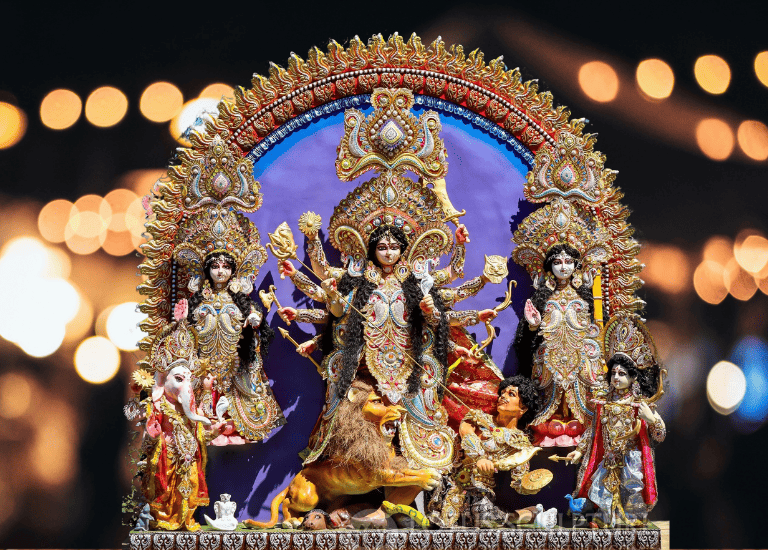
During the festival of Navratri, which leads up to Vijayadashami, devotees worship the nine forms of Durga, celebrating her strength, wisdom, and compassion. On the final day, Vijayadashami, her victory over Mahishasura is commemorated with great enthusiasm, particularly in eastern India, where large statues of the goddess are immersed in water (Durga Visarjan) as part of the celebrations.
Significance of Dussehra and Vijayadashami

Both the stories of Lord Rama and Goddess Durga serve as powerful metaphors for the battles we face in our lives. Dussehra reminds us that good will always prevail, even in the face of great adversity. The festival’s message is universal – it speaks of courage, righteousness, and the importance of standing up against injustice and evil.

Cultural and Spiritual Unity:
Dussehra and Vijayadashami bring people together, celebrating the rich cultural and spiritual heritage of India. The rituals, processions, and reenactments of the stories create a sense of unity among communities. Whether it’s through the grand effigies of Ravana being burnt or the immersion of Goddess Durga’s idols, the festival fosters a sense of shared belief in the triumph of good over evil.

Victory of Dharma Over Adharma:
Both stories highlight the importance of living a life guided by dharma (righteousness) and upholding moral principles. Lord Rama’s unwavering commitment to dharma, despite the challenges he faces, and Goddess Durga’s fierce determination to restore balance and defeat evil, remind us to stay true to our values.

Inner Battles and Personal Growth:
Dussehra is not just about external battles but also symbolizes the internal struggle between good and evil within us. Just as Lord Rama fought Ravana and Goddess Durga battled Mahishasura, we too must confront the negative emotions and vices within us, such as anger, greed, and pride. The victory of good over evil in these stories serves as an inspiration for self-reflection and personal growth.

Rituals and Celebrations

Dussehra and Vijayadashami are marked by a variety of vibrant rituals and traditions across India, each region celebrating in its own unique way. Here are some of the key rituals:

Ramleela Performances:
In many regions, the story of Lord Rama’s battle with Ravana is performed through Ramleela, a dramatic reenactment of the Ramayana. These performances captivate audiences, reminding them of the values of truth, honor, and courage.

Ravana Dahan:
In many parts of India, enormous effigies of Ravana, his brother Kumbhkaran, and his son Meghnath are set on fire. This ritual symbolizes the destruction of evil forces and is often accompanied by fireworks and celebrations.

Durga Puja and Visarjan:
In eastern India, especially in West Bengal, Durga Puja is a major celebration. Devotees build beautiful pandals (temporary structures) to house the idols of Goddess Durga. After days of worship, these idols are taken in grand processions to rivers or the sea for immersion, marking the end of the festival.

Navratri Celebrations:
Across India, Navratri is celebrated with great enthusiasm leading up to Vijayadashami. Each day of the nine-night festival is dedicated to a different form of the goddess, and people participate in traditional dances like Garba and Dandiya, especially in Gujarat.

Conclusion

Vijayadashami and Dussehra are more than just festivals—they are a reminder that good will always triumph over evil, both in the world and within ourselves. The stories of Lord Rama and Goddess Durga serve as timeless lessons, guiding us to lead lives rooted in righteousness, courage, and compassion.

As we burn the effigies of Ravana and celebrate the victory of Goddess Durga, we are reminded to confront the evils we face in our own lives—be they external challenges or internal struggles. The festival encourages us to strive for balance, uphold truth, and believe in the power of good to overcome even the darkest forces.

Let us carry the spirit of Vijayadashami with us throughout the year, drawing inspiration from these ancient tales as we navigate the challenges of modern life, always remembering that good will ultimately prevail.
How to Perform Navratri Durga Puja?

DURGA POOJA

For Hindus, Navratri is considered a vibrant as well as auspicious festival of nine days that is dedicated to worshiping the nine avatars or forms of the goddess Durga with great enthusiasm and devotion. During these sacred nine days, devotees commonly engage in activities like fasting, prayers, as well as various other rituals to seek blessings, strength, and prosperity from goddess Durga. Nevertheless, performing a Navratri puja at your home is not just a religious activity, as it is also considered as one of the best ways to feel more connected with your cultural roots, even if you’re living away from your hometown, like in the USA, Canada, etc.

Thus, whether it’s your first time performing the Navratri puja or you have been practicing it for years, here in this article, we’ll guide you through the step-by-step process of how to perform this puja in the comfort of your home without missing any of the traditions.

What is Navratri?

In Hindi, Navratri means ‘nine nights’ which is one of the many auspicious festivals celebrated across India to worship the nine forms or avatars of goddess Durga in order to seek her blessings. According to the Hindu calendar, the Navratri comes two times in a year, once in the Chaitra month to celebrate the Hindu new year and the other in the Ashwin month to celebrate Dussehra, which signifies the winning of Lord Rama against Ravana. 

Nevertheless, each day of the Navratri is dedicated to one form of the goddess, which signifies her specific powers. Thus, Navratri is also considered as a season of spiritual cleansing as well as seeking favors or healings for health, wealth, and peace from the goddess.

Click to view this 13″ Brass Durga Statue

Guide to Perform Navratri Puja at Home 

1. Preparation for Navratri Puja

It is considered as very important to prepare your mind, body, as well as home before starting the Navratri puja, as cleanliness and purity are the keys to beginning the rituals.

Clean Your Home: 

Before beginning the puja, it is mandatory to thoroughly clean the area where you plan to perform the puja. This space should be free from any potential distractions in order to make you solely focus on your puja. Therefore, it is advised to create a small space or corner where you can place the idols or pictures and all the other necessary items to worship the goddess Durga without any disturbances during these nine days.

Set Up the Puja Altar: 

  • Firstly, place the pictures of idols of goddess Durga or any of her nine forms on the altar. 
  • Now, decorate the altar with beautiful fresh flowers, incense as per your liking and also a lamp that directly faces the direction of goddess Durga idols. You can also leave some space on the altar to offer fruits, sweets, etc. to the goddess during these days.
  • Now, place a small Kalash (pot) filled with water, add a few drops of Ganga Jal (Ganga water) and place a coin in it. Then, put a coconut on it and decorate the entire pot by partially inserting Ashok leaves (Saraca indica leaves) in it. 

2. Sankalpa (Vow)

Once you set up your altar, then sit down with a relaxed mind on the mat to take the Sankalpa (vow or commitment). It is taken to perform the puja wholeheartedly as well as to perform fasting and other rituals with sincerity.

How to Take Sankalpa: 

  • Face the east or north direction in the space you have created for the puja and join your hands in a prayer position.
  • Now, chant the mantra, “Om aim hreem kleem chamundaye vicche.” for as many times as you can.
  • Now, meditate on goddess Durga and express your wish to perform the puja wholeheartedly for the nine days with sincerity.

3. Invoke Goddess Durga

Whenever you’re done with the Sankalpa, then it’s time to invite the goddess Durga into your home to stay there during these nine days. This ritual begins with ghata sthapana or kalash sthapna (pot installation) in another pot, which is filled with soil and some barley seeds sprinkled on it.

Kalash Sthapana (Pot Installation): 

  • Firstly, decorate the coconut, which you have placed upon the kalash (pot) previously, with turmeric and kumkum powder and then place it in the pot of soil. 
  • Now, light the ghee lamp and some incense sticks to invoke the presence of goddess Durga into your home. You can also offer fresh flowers, fruits, sweets, etc. to the deity and chant the durga mantras with full concentration, like “om dum durgayei namaha….” for 108 times if possible.

4. Chanting Mantras and Reciting Durga Saptashati

Chanting the mantras of goddess Durga and reciting scriptures like Durga saptashati or Devi mahatmya are considered as a very important part of the Navratri puja in order to get the blessings of the goddess Durga. Therefore, it is highly advised that you should recite at least a few chapters every day or you can also play the recorded chants if you don’t know the verses. You can chant mantras like “Ya Devi Sarva bhuteshu…” to offer your prayers to the goddess in order to seek protection as well as blessings from her.

5. Offer Bhog (Food Offering)

It is considered as very important to offer bhog during the Navratri to the goddess Durga. You can also offer different foods on each day of the Navratri according to the specific preferences of the goddess for that particular day. For example, you can offer pure milk-based products such as kheer (rice pudding) to goddess Shailputri on day-1, sugar and fruits like apples and bananas to goddess Brahmacharini on day-2 and so on. Once you offer the food to the goddess, then you can share it with your family members as a prasad in order to share the blessings of the goddess among them too.  

6. Aarti and Devotional Songs

Performing the aartis, which are often called as devotional songs, are considered as one of the most blissful parts of the Navratri puja and they are performed two times a day, usually once in the morning and once in the evening.

To perform the aarti, you should light a camphor in a vessel and move it in a circular motion in front of the deity while signing the aarti, like “ambe tu jagdambe kali, jai durge khappar vali…” which is also considered as a very popular aarti among the devotees to seek the blessings of goddess Durga. 

7. Navratri Fasting

Taking a fast during the Navratri is considered as one of the most important parts of the entire festival, as it is believed to cleanse both your body as well as your soul. This practice also represents your devotion as well as self-discipline to the goddess Durga, which can be a way to enhance your spiritual connection with the divine. There are various ways in which the devotees can choose to fast, like:

  • Full Fast: In this practice, the devotees avoid consuming any type of food throughout the day. Some devotees may only consume water, while others allow for light liquids like coconut water or fresh fruit juices according to their likings as well as keeping their health in mind.
  • Partial Fast: This fasting involves eating certain foods that are often called as ‘vrat-friendly’ and don’t break your fast, like fruits, dairy products, and special grains like kuttu ka atta (buckwheat flour), singhare ka atta (water chestnut flour), or sabudana khichdi (tapioca). This practice is very common among devotees, as it makes the nine days of the fasting quite manageable without compromising on their health.

8. Kanya Pujan (Worshiping of Young Girls)

It is considered as a mandatory tradition to perform Kanya pujan, in which worship of nine young girls, usually below the age of 11-12 years, is performed. This ritual represents the nine forms or avatars of goddess Durga worshiped on the Astami (eighth day) or Navami (ninth day of the Navratri).

How to Perform Kanya Pujan: 

  • Firstly, wash the feet of the young girls, then serve them a meal that usually contains halwa, puri, and chana. You can also give them fresh clothes or gifts as per your liking to welcome them into your home on the auspicious day. 
  • This Kanya pujan is also considered as a symbol of worshiping the goddess Durga in her young forms, as it is believed to bring blessings of both health and prosperity into your home.

9. Visarjan (Concluding the Puja) 

The Navratri puja ends with the final rituals of visarjan (immersion) of the idols of goddess Durga in the ponds or any other suitable place in order to offer her a farewell. It is also performed to thank the goddess for her blessings as well as to pray to her to return next year with the same joy and prosperity. Then, you can either water the plants with the kalash water or sprinkle it into your home in order to retain a positive vibe throughout the day.

The Navratri puja is considered as an auspicious journey of spirituality, self-discipline, as well as devotion to the goddess to show us the right path and also to seek blessings of great health and prosperity from her. Nevertheless, now you may be able to perform these rituals without any hindrances in the comfort of your home by following the above steps in order to stay connected to your cultural roots as well as to seek the blessings of goddess Durga.

Are you also looking for the best-handcrafted goddess Durga idols to enhance your Navratri puja experience? Then, visit Lotus Sculpture today to get the best-handcrafted sculptures of goddess Durga to invoke her divine presence into your home.

Legends of Hindu Goddess Durga: The Invincible

View All Our Goddess Durga Statues

Durga is a vicious form of Hindu Goddess Devi, known for her indestructible nature.  She is commonly depicted with 18 arms all carrying weapons as she rides atop a fierce tiger. She carries a weapon given to her by each of the Gods including Hindu God Indra’s (God of Destruction) lightning bolt and Hindu God Vishnu’s (The Preserver) Discus.  These weapons are endeared to her as a defender of the world.  She is frequently seen slaying demons especially the buffalo demon known as Mahishasura.  It is said that she was created in order to fight off the incredible might of the asura Mahishasura, who could not be defeated by any male or god alike.  Mahishasura had been reigning incredible terror upon the earth and as the gods became helpless, Hindu God Shiva turned to his wife Parvati for help.  Parvati responded by traveling to an ashram to take on the role as female goddess warrior. The Gods also turned to Brahman, the supreme creator of all gods, for help and together they banned together emitting beams of light from their bodies.  The beam of light expanded to the Ashram where Hindu Godess Parvati had ventured and out of the light Durga was born, a fierce and eager female warrior goddess. She was formed of the female aspects of Brahman just as Shiva had once been formed of Brahmans male counterparts.  The gods were blessed and endeared by her.   As she fought with the revered Mahishasura she exclaimed:

“Roar with delight while you still can, O illiterate demon, because when I will kill you, the gods themselves will roar with delight”.

Eventually paralyzed by the blinding light constantly emanating from Durga’s body, the buffalo demon was slain with one swift slice of her sword as she erupted in laughter.

This account of her ferocious stand off and conquering of the buffalo demon is celebrated annually in the national festival Durga Puja, which falls on October 19-24th of 2012.  As an endeared Goddess, Durga’s divine feminine energies are thought to be a manifestation of all the gods.

To learn more about the Hindu Gods CLICK HERE