Navaratri 2025- Significance of 9 Days of Navaratri

durga statue

Navaratri, is the most sacred Hindu festival on the calendar. It’s a colorful celebration of the divine feminine principle, or Shakti, and good triumphing over evil. Believers worldwide worship Goddess Durga in her nine forms for nine nights and ten days. The festival is a period of greater spiritual self-awareness, discipline, and group solidarity resulting in celebratory victory in Vijayadashami.

This year, Navaratri will be from Monday, 22 September 2025, to Wednesday, 1 October 2025, and Vijayadashami on 2 October. Each of these nine days celebrates a different quality of the goddess, mapping a gripping narrative of power, innocence, and final victory. This is a guide to each of these nine holy days.

The First Three Nights: Honoring the Warrior Goddess Durga

The first three evenings are all in honor of Goddess Durga since she represents strength, power, and courage. They are evenings to call upon us to overcome our own weaknesses and set us up for the spiritual journey before us. The goddess in her fiery form is invoked to destroy evil qualities and cleanse the mind. The spiritual energy of a lovely Durga statue as part of home furnishings can be a reminder of this power.

durga statues
Explore Goddess Durga Statues

Day 1: Goddess Shailaputri

Goddess Shailaputri, the “Daughter of the Mountain,” is the focus of the first day. She is the daughter of Himavan, the embodiment of the Himalayas, and thus the embodiment of the simple power of nature and the beginning of a new religious path. She rides a bull, carrying a trident and a lotus. Her worship is a beginning as she symbolizes the start of the festival and the divine power that pushes us ahead. Keeping a calm Shailaputri statue in your house can bring beginnings.

Day 2: Goddess Brahmacharini

The second day is devoted to Goddess Brahmacharini, the devotion and penance goddess. Her name is “one who practices Brahmacharya,” or spiritual discipline. She is shown walking barefoot, carrying a rosary and a water pot. Her physicality is a lesson that through patience, will power, and self-control, we can surmount anything. She is the ultimate symbol of self-control and patience, which are required to attain any spiritual heights. A stunning Brahmacharini idol can bring concentration and discipline to your life.

Day 3: Goddess Chandraghanta

The third day devoted to Goddess Chandraghanta, the married form of Parvati. She has been named thus because she wears half-moon bell (chandra-ghanta) on her forehead. She is a terrifying person of valour and tranquility, ready to fight against evil and yet showering tranquility on her devotees. Ten arms of hers carry various weapons, but she remains peaceful and elegant. Offering a puja to her grants courage and good sense of mind to a person. The strength and serenity of Durga statues perfectly embody this lovely combination of strength and peace, and therefore any Durga sculpture can be a good addition to a household. You can also find a rare Chandraghanta idol that offers worship on this day.

The Next Three Nights: Celebrating Abundance and Motherhood

The next three nights are spent in honor of Goddess Lakshmi, the goddess of prosperity, wealth, and spiritual richness. This is the section of the festival where requests are placed for the invocation of good energies and blessings for a peaceful and joyful existence. A peaceful white marble Durga statue would typically be the preference for this section of the celebration.

lakshmi & saraswati statues
Explore Goddess Lakshmi Statues

Day 4: Goddess Kushmanda

We pay our respects to Goddess Kushmanda on the fourth day. She is the creator of the world, having created the world with her pleasant smile. She has eight arms, which are filled with various objects representing her creative power and dominance over the world. Worship in her name is said to attain good health, wealth, and happiness. She reminds one of plenty and the abundance of opportunities in the world. A colorful Kushmanda idol can occupy your space with creative energy.

Day 5: Goddess Skandamata

The fifth is to Goddess Skandamata, mother of Lord Skanda (Kartikeya), war lord. She embodies the virtues of maternal love and compassion. Her benevolent form is depicted with her son on her lap. She is also worshiped to bring peace and wisdom, and is revered as the world mother. The day is more important for mothers, as they pray to her for good wishes for the health of their child. A serene Skandamata statue is a beautiful symbol of motherhood.

Day 6: Goddess Katyayani

Goddess Katyayani, who is a ferocious war manifestation of Durga created by the collective fury of the gods to defeat the demon Mahishasura, is the goddess of the sixth day. She is seated upon a lion and represents absolute power and willingness to engage in battle to right what is wrong. She is the power that destroys evil and makes righteousness the conqueror. A grand durga statue for outdoor space can represent this strong presence, and a beautiful Katyayani statue can also represent her fearlessness.

The Final Three Nights: Embracing Wisdom and Spiritual Fulfillment

The last three nights are dedicated to Goddess Saraswati,the goddess of knowledge, wisdom, and spiritual consciousness. The latter half of the festival is all about spiritual wisdom and celebrating the strength of inner consciousness. A sophisticated brass Durga sculpture can echo this refined subtlety.

Day 7: Goddess Kalaratri

The seventh night is all about Goddess Kalaratri, the most violent and frightful form of Durga. Her name is “the one who is the death of time.” She is the destroyer of ignorance, darkness, and evil spirits. Her appearance may be horrendous, but she is most dearly protective of her devotees. She is connected with the raw energy of transformation. Her intense form is inextricably linked to Goddess Kali, and worshipping her makes an individual transcend all kinds of fear and instill inner strength. The energy of a Kali statue for the altar wonderfully captures this aspect of the divine. You may also request a special Kalaratri idol to keep at home.

kali statues
Explore Goddess Kali Statues

Day 8: Goddess Mahagauri

We worship Goddess Mahagauri, the goddess of peace and innocence, on the eighth day. Her complexion was darkened after she did very heavy penance, but Lord Shiva cleansed her in the Ganga River and her complexion became fair again. She is peaceful, forgiving, and gentle. Her worship cleanses a devotee’s life and makes it beautiful and peaceful. Kanya Puja can be done today when little girls are worshiped as forms of the goddess herself. A serene figure of Mahagauri is a stunning embodiment of such purity.

Day 9: Goddess Siddhidatri

The ninth and last day is for Goddess Siddhidatri, the giver of supernatural power and spiritual wisdom. She is said to bestow all types of success and knowledge upon her followers. She sits on a lotus and holds a mace, discus, conch shell, and lotus in her hands. Her worship on this day brings the spiritual practice of Navaratri to its culmination in the best possible way since she fulfills all desires and grants all wishes. She is the epitome of spiritual practice and devotion. A beautiful Durga idol is generally a center of attraction on this last day, and throughout the year, a Siddhidatri idol can bless your house with flowers.

The Meaning of Navaratri

Navaratri is not merely a ritual festival. It is a tremendous call to action that we have to bridge to our own individual triumph, and it is from spiritual self-control and impartial heart that we derive power. The festival marks passing through the state of sanctity (Durga), to the state of prosperity (Lakshmi), to enlightenment (Saraswati). It is one of joy and uniting as a community in worship. It reminds us that divine feminine is a source of wisdom, power, and creation. That is why having a physical presence, such as a sacred Durga statue, can be such a vital part of one’s daily life.

Day 2 of Diwali Festival of Lights: Choti Diwali

Today, November 14th, marks the second day of the 2012 Diwali Festival of Lights known as Choti Diwali, Naraka Chaturdashi, or Kali Chaudas.  It is the 14th day of the Hindu month of Ashwin and the most important day of the festival for South Indians.  Legend has it that on this day God Krishna defeated the evil demon Narakasura and is therefore celebrated by Hindus as a triumph of good over evil and light over darkness.  It is not surprising then that Kali, which translates as dark, the Goddess of death, time, and change, is celebrated.
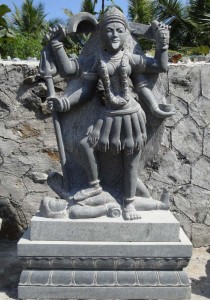
View all our Hindu Goddess Kali Statues

On this day of Diwali many perform Poojas, or religious offerings, for Lakshmi and Rama with delicious foods.  It is also tradition to bathe in fragrant oils before the sun comes up early in the morning and wear fresh new clothing as part of the day’s ritual.  Bathing under the cloak of darkness and stars is regarded as honoring the holy river of Ganges.  Families and friends gather together for shared meals and celebrate the richness of the day with song and collective activities.

The morning after Choti Diwali women often make beautiful Rangoli around their houses and yards.  Rangoli are artistic designs made on the floors of Hindu households and yards during religious festivals.  They are thought to be welcoming areas for the Gods and are traditionally made from colored rice, colored flour, sand, and flower petals.

To celebrate, gather materials around the house such as rice, grains, flower petals, beads, or anything small and vibrant in color.  Use dyes or food coloring to add color to less than vibrant pieces.   Once you have gathered up enough supplies, make the entrance way to your home or business colorful using what you have collected.  This is a joyful way to welcome the Goddess of Wealth and Prosperity Lakshmi to your home so that she may bless you in the coming year. Examples of Rangoli designs can be found across the internet for inspiration!

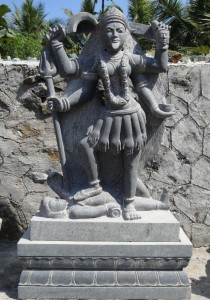
Legends of Hindu Goddess Kali: the Dark One

fierce form of Devi hindu goddess Kali
Click here view all our Goddess Kali Statues

According to Hindu teachings, Kali is Goddess of time or change, but is most notably known by non-Hindus for her darkness and violence.  Much like Shiva in the form of Bhairava, her earliest incarnation was that of an annihilator of evil within the world.  She is often depicted in grotesque fashion as her terrifying eyes and shrieking expression horrify. Kali is referred to as ‘the black one’ as she is thought to have been the first creation before light itself and her very presence is said to convey death and destruction.

Within her most famous Hindu legend she comes to the aid of Hindu Goddess Durga and her assistants as they attempt to slay the demon Raktabija.  They attempt to wound him with various weapons but come to find that with every drop of blood they inflict he only multiplies in form.  His duplicates overwhelm them and they call upon Kali for aid.  Instead of Kali being summoned, however, Durga herself manifests into Kali’s form.

‘Out of the surface of her (Durga’s) forehead, fierce with frown, issued suddenly Kali of terrible countenance, armed with a sword and noose. Bearing the strange khatvanga (skull-topped staff), decorated with a garland of skulls, clad in a tiger’s skin, very appalling owing to her emaciated flesh, with gaping mouth, fearful with her tongue lolling out, having deep reddish eyes, filling the regions of the sky with her roars, falling upon impetuously and slaughtering the great asuras in that army, she devoured those hordes of the foes of the devas’

Kali slays the Raktabija by sucking every last ounce of blood from his body and devouring his duplicates.  She rejoices in victory and dances upon the fallen in triumph.  Her ferocious celebration is said to have consumed her fully, unable to stop herself from stomping on the slain.   In order to snap his consort Kali out of her violent elation, God Shiva laid down amongst the dead beneath her feet.  The instant her foot touched her beloved Shiva she was able to calm herself.  This is why Kali is often depicted standing atop Shiva.

Although Kali is often seen as a terrifying and vicious slayer of demons, in union with Shiva she is said to help create and destroy worlds.