Nataraja vs. Meditating Shiva vs. Ardhanarishvara: Which Form to Choose?

nataraja statues

Have you ever experienced walking into a room and suddenly feeling a change in the atmosphere? Possibly the area seemed to you to be so relaxed that everything was under control, or, on the contrary, it was so full of a sudden powerful surge of the highly concentrated, inventive energy. Gifting Mahadeva to your home is no mere matter of decor. Shiva is capable of manifesting himself as the immortal dancer, the silent meditator, as the divine duality of masculine and feminine energies and every incarnation has its own very distinct spiritual and visual essence.

If you are wondering which form to buy, the answer depends entirely on the atmosphere you want to cultivate. Let’s look at how to choose the right form for your lifestyle and goals.

Shiva Statue
Meditating Shiva Statue


The Intersection of Modern Decor and Conscious Spirituality

Before you dive into room layouts and Vastu principles, it helps to understand why the statue’s physical shape matters so much. In sacred art, a masterfully crafted sculpture is more than a display piece; it becomes a kind of visual conduit for a specific energy, almost like it channels something. A dynamic form adds a sense of motion and a sort of revitalisation to a room, while a still form gives it stability, grounds the space, and, yes, serves as an anchor of peace.

Whether a beautiful bronze piece intricately made by the traditional lost wax method, a heavy brass work of art, or a finely hand-carved stone deity, you would like to be sure that its spiritual intent goes hand in hand with your way of living. Here are the main aspects of the three principal manifestations of Lord Shiva that will help you make the right decision for a spiritual retreat in your home.
 

Lord Nataraja: The Cosmic Dancer

In case you find your space to be dull or stagnant, then the form of Nataraja is considered to be able to infuse new energy into the environment.

Nataraja statue
Nataraja statue Collection


The Iconography and Energy

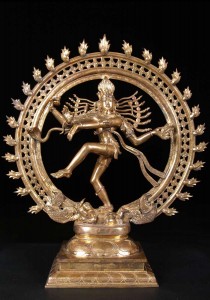
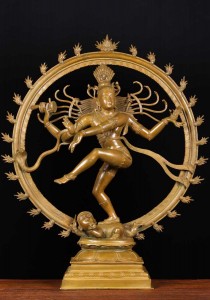
In this magnificent kind of form, Shiva feels like he’s captured mid-dance inside a blazing halo, while he balances on one foot atop a small demon who looks like he shrank down. The Nataraja statue’s meaning turns into a profound lesson about the rhythm of existence, like creation, preservation, destruction, illusion, and liberation all moving together, not in a neat line but kind of in motion. He’s holding a drum (damaru) that drums out the pulse of time, plus fire that stands for change that can not be avoided. The energy here is dynamic, really active, and honestly deeply inspiring, like it keeps pulling you forward even when you’re just looking.
 

Ideal Placement & Material Recommendations

Because Nataraja represents fast momentum and cosmic fire, your Shiva statue placement vastu decisions need to be intentional, not just “wherever it fits :

  • Where to put it: Put it in a main living room, a creative studio, an office, or any space that gets used daily, especially where brainstorming, artistic work, and general activity happen.
  • Where to avoid: Don’t put a Nataraja statue in the bedroom, or in a quiet study corner. That intense, active energy can mess with your sleep, your rest, and that calm kind of focus people want.
  • Material Tip: A rich, heavy bronze or brass Nataraja looks stunning under direct spotlighting, emphasizing the intricate details of the flames and dancing limbs.


Meditating Shiva: The Ultimate Yogi

On the complete opposite end of the spectrum sits the yogic form of Mahadeva. If your everyday life is fast-paced, kind of hectic, and filled with digital noise, this is the anchor your home really needs. 

Shiva Statue
Shiva Statue Collection


The Iconography and Energy

Here, Shiva is seated in a deep lotus posture (Padmasana), his eyes gently closed, his hands resting in his lap, and a quiet kind of smile on his face. He feels completely turned inward, not really bothered by the chaos of the outside world. His trident (trishula) rests quietly near him, like a small sign of steadiness over the mind, ego, and all those restless wants.

The presence of a Shiva statue in meditative pose at home will immediately give you a sense of calmness, as if your nervous system gets a visual cue to slow down, relax, introspect, and find peace within yourself.

Ideal Placement & Material Recommendations

To pull out the maximum calming value from this yogic form, stick to these classic Vastu guidelines:

  • Where to put it: The northeast corner of your home, the Ishanya corner, is considered ideal for meditation, clarity, and spiritual growth. Place your meditating Shiva there, preferably facing north or east. It works really well in a dedicated altar room, a quiet reading corner, or a serene entryway, so visitors step in with peace before they even speak.
  • Material Tip: Hand-carved white marble, dark granite, or natural volcanic stone works really well for this yogic shape. Something about the carved weight of it feels right, like the room can hold calm energy. These natural, earthy materials soak up the quiet vibe, and they also throw out a gentle, grounding halo that invites deeper meditation.


Ardhanarishvara: The Divine Synthesis

If you want to find more harmony in your relationships or maybe mix logic with intuition a bit better, then Ardhanarishvara is worth looking into.

The Iconography and Energy

Ardhanarishvara is this composite form of Shiva split down the middle. The right side is male, and the left is female, as Parvati. This represents non-duality in the universe where masculine and feminine energies are inseparable. It is about harmony and balance mostly. Some parts feel like they emphasize equality and wholeness as well. I am not totally sure how all the details line up, but that is the main idea.

The energy of this form feels centred on harmony, steadiness, equality, and wholeness. It’s also this bold visual nudge that real strength doesn’t only mean power, it means compassion too and somehow logic and intuition have to work together, not fight.

Ideal Placement & Material Recommendations

Because this form directly addresses the balance of relationships, its placement is highly specific:

  • Where to put it: This is a really standout option for a main living room, where the family naturally gathers, because it encourages shared respect and a calmer flow of communication. You can also place it in a main bedroom to help create harmony between partners.
  • Where to avoid: Try not to put it near bathrooms, kitchens or in cluttered storage areas, because it can disturb the careful balance of the divine energies. Sometimes people forget this part, but it matters.
  • Material Tip: Go for top-quality two-tone metals or stones with well-done carvings, so the small differences between the two sides can be noticed up close and in a quiet way.


Making Your Final Decision

Sometimes you can simplify things by just looking at what your life is missing right now. 

  1. Nataraja could be good if you need motivation and creative inspiration. It also gives courage for major life transitions.
  2. Pick Meditating Shiva if you want stress relief, stronger mental clarity, spiritual discipline, and an oasis of calm, you know that quiet steadiness.
  3. Pick Ardhanarishvara if your focus is relationship healing, deeper internal balance, and learning unity in your home in a real, everyday way.


A Note on Mindful Devotion

No matter which form you bring home, remember that a sacred statue is not only a design accent or decor idea. Treat it like it matters. Keep the space clean, uncluttered, bright, and raised off the floor on a dedicated altar, table, or mantel, so it’s given proper respect to the ancient skill and the deity.

Take a look at our authentic, museum-quality collections to discover the right Shiva Nataraja Statues, or just browse the full range of Hindu God Shiva Statues to refresh your home sanctuary today.

Hindu God Shiva: Destroyer & Creator

Hindu God Shiva as Lord of Dance Nataraja
Shiva destroys and creates the world anew as the Lord of Dance, Nataraja!

When many first hear of the Hindu God of Destruction, Shiva, they automatically think of something evil or alarming.  They think him something to be feared.    Yet, his powers are constructive, not just destructive.   He brings about necessary and beneficial transformation.   It can be said that the world is in a constant state of flux.   Just as life is given at birth, so too must it eventually cease to exist.   In that same regard, the world is constantly evolving and partaking in birth, deaths, and rebirths.

Hindus believe that Hindu God Shiva is responsible for the destruction of the universe in order that he may then re-create it into a more perfect form.  They believe that even now he infiltrates the world in order to shed illusion and destroy the worlds many imperfections.  Not only is he the Destroyer, he can also be thought of as a god of change or formation, causing a constant cycle of destruction and creation in order to bring about necessary good.

There is no doubt that the world as we know it houses many flaws.    In order to bring about real change, Hindus look to Shiva to re-create the world in a better image.  Worshipers look to him for guidance in ridding their troubles.  They may pray upon a Shiva statue so that he may bring about renewal in the world.  Many worship Shiva as their primary God.   Join Hindu’s around the world in worshiping Hindu God Shiva for both his destructive and constructive qualities.

Bring a Shiva or other Hindu statues into your home or place of worship from Lotus Sculpture.
Hindu God Nataraja, Shiva as the Lord of Dance

Statues of Hindu God Shiva the destroyer
View our statues of the Hindu God Shiva

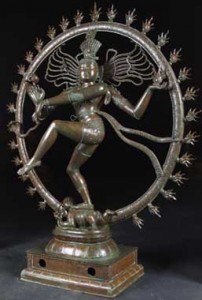
Shiva, Hindu God of Destruction, is also known as Nataraja, Lord of Dancers, in one of his most popular forms.  He is depicted as sacred dancer, dancing to restore the universe of its fatigued nature making way for Brahma to create within the universe.  He has a restorative power revitalizing the universe and preparing for growth.  Shiva as Lord Nataraja is his most popular within Hindu temples. His likeness is often sculpted in bronze as Shiva dances around a ring of flames.  His left leg is often raised balancing over a lesser being that stands as a metaphor for the ignorance of the world.  Shiva as Nataraja is a powerful symbol of Indian culture for its spirit and energetic nature.  He represents the precise flow and generation of the universe.  Shiva as Nataraja is perhaps the most renowned symbol of Hindu art.

Nataraja statues
View our statues of Nataraja the Lord of Dance

Shiva’s dance is often said to come in two forms.  The first form represents the gentle, or the nature associated with creation upon the earth, while the second from is said to be that of violence as he destroys the tired and suffocating ways of the universe.  Shiva terminates what is weary in order to create what is profound. He tears down the old in order to make way for the new.

Legend has it that one day Shiva journeyed to a thick forest in the South of India in order to confute with the multitude of heretical sages that lived within.  Traveling with him was Hindu God Vishnu, The Preserver, disguised as a woman.  Upon arrival, the sages became very angry towards Shiva and attempted to destroy him via powerful incantations.  They first induced a violent tiger which was no match as he skinned it in one foul swoop and draped it around his body like a blanket. Next appeared a deadly serpent of which Shiva quickly overtook and hung like a necklace about his neck.  Through all their confrontation simply Shiva danced about their ring of fire laughing, destroying everything they threw his way.  Thus, Shiva became the lord of dancers, a symbol of the divine.

Shiva, Lord Nataraja Quotes

Bronze Shiva Nataraja statue

“Because You love the Burning -ground, I have made a Burning-ground of
my heart – That You, Dark One, hunter of the Burning-ground, May dance
Your eternal dance.”
~ Bengali Hymn~
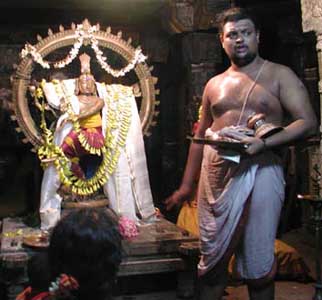
Nataraja in Puja ceremony
Bronze Nataraja statue in puja ceremony

“The source of all movement,
Shiva’s dance,
Gives rhythm to the universe.
He dances in evil places,
In sacred,
He creates and preserves,
Destroys and releases.
We are part of this dance
This eternal rhythm,
And woe to us if, blinded
By illusions,
We detach ourselves
From the dancing cosmos,
This universal harmony…”
Ruth Peel

“O my Lord, Thy hand holding the sacred drum has made and ordered the heavens and earth and other worlds and innumerable souls.  Thy lifted hand protects both the conscious and unconscious order of thy creation.  All these worlds are transformed by Thy hand bearing fire.  Thy sacred foot, planted on the ground, gives an abode to the tired soul struggling in the toils of causality.  It is Thy lifted foot that grants eternal bliss to those that approach Thee.  These Five-Actions are indeed Thy Handiwork..”
~ Chidambara Mummani Kovai~
Hindu God Shiva Nataraja statue
4 Foot tall Dancing Shiva as Lord Nataraja

O Lord Nataraja of Chidambaram,
King Dancer of Thillai Ambalam,
Beloved consort of Sivakami Sundari,
Bhuvanesvari, Rajarajesvari,
Destroyer of sin, bestower of prosperity,
Remover of suffering, giver of Immortality,
Sivaya Nama Om Sivaya Namah,
Sivaya Nama Om Namah Sivaya.

Holder of Trident, drinker of poison,
Master of Yogis, ruler in the Sun,
Dweller in Kailas, rider of Nandi
Destroyer of Cupid, Lord of Siddhi,
The three-eyed Lord, the five-faced God,
The blue-necked God, the God of gods,
Sivaya Nama Om Sivaya Namah,
Sivaya Nama Om Namah Sivaya.

Thou art my Guru and sole-refuge,
Salutations unto Thee O Lord of Mercy,
Bless me with Thy shower of Grace,
Let me behold Thy benign face,
Let me merge in Thee for ever,
This is my real fervent prayer.
Sivaya Nama Om Sivaya Namah,
Sivaya Nama Om Namah Sivaya.

The Kung Foo Brothers, Bronze in Swamimalai!

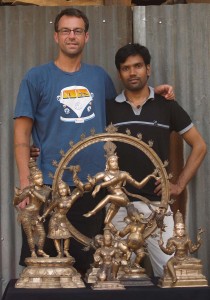
Varadaraj and I and some of his bronze creations

I met Vardaraj, Varun, and Sini 8 years ago in the first years of Lotus Sculpture. Varadaraj is the eldest, Varun is in the middle and Sini is the baby. They were three kids who just broke away from a bronze collective they were apprenticing at for the past ten years to start their own bronze collective. I was their first customer. Immediately I could see they were different. They were young, loved making bronze statues, and had big ideas for their future. I saw myself in them as we both were striving towards the same goals. In our first meeting I also discovered Varun, the middle-aged brother wanted to be in Kung foo movies. I still remember that exchange when he told me his future plans. “Like Jackie Chan!'”, he said eagerly. I made him repeat it several times as I really couldn’t believe my ears and in the end came the conclusion that this tall, muscular kid from Swamimalai had bigger dreams outside of the bronze casting business. Everyone can dream! From that day on my relationship and love for the Kung Foo Brothers, as I started to refer to them, has grown 100 fold. They are part of my Indian family!

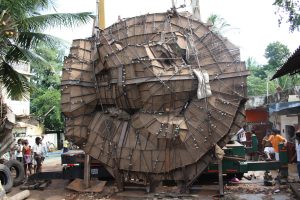
23 foot Nataraja in mold
23 foot Nataraja is its earthen mold ready for casting!

Immediately I could see they were different than other bronze artists. They were young, loved making bronze statues and had big, ambitious plans for their future

Vardaraj, the oldest, had a different dream. Besides casting the best statues Swamimalai has to offer he wanted to make the world’s largest Nataraja statue. After arriving at his workshop this afternoon I saw how close he is to realizing his dream. The Nataraja is ready for casting! The Nataraja is 23 feet tall and will weigh a total of 10 tons of pure bronze! View this amazing Nataraja! After we climbed over the enormous mold of the Nararaja I then moved inside to view my, more modest bronze statues. They are experts at the Nataraja form and I took in the 4 Natarajas I commissioned. Each a perfect representation of Shiva’s dance of destruction. In each statue, Shiva is suspended upon the prostrate dwarf, Apasmara, like he is flying, light as a feather. In my opinion, there is no statue form as fine as a Nataraja with perfect proportions. It will always take a little of my breath away to see a masterpiece Nataraja as Varadaraj is so adept at creating!

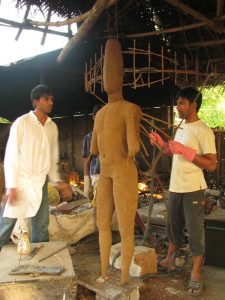
Varun and Varadaraj working on a wax model of Ravendra

I spent two days with the family and enjoyed their youthful, smiling mother’s, “Mama’s” cooking for lunch each day. It is always my favorite meal in India a mixture of prawn curry, chicken masala, and coconut rice that is impossible to find made with such love at any restaurant. I bought them an iPhone which we spent a couple of hours figuring out the inner workings to the phone. I love watching the interplay between the three brothers. They are so close I really think they can read the mind of each other. Whenever they are sitting together they have an arm over each other’s shoulder, whispering into the others’ ear. I often feel like I am intruding as their exchanges feel so private and personal.

While roaming around the now 30 workers Varadaraj now has working for him, I took many videos of the lost wax method process to show in more detail how south Indian bronze statues are made. The process is incredibly long and tedious with 5 separate steps. I thought video is the best way to illustrate with bronze statue making process. People oftentimes say the prices of bronze are too high on Lotus Sculpture. I know that when one fully understands the entire process and the overall work that goes into the making of one bronze statue you will wonder why they are so inexpensive! I will be adding these and many other videos to our site and youtube channel in the coming weeks.

By far my favorite piece of news I have received on this trip was that Varun has received a role as the hero in an action film in Chennai that starts filming in two months!!! He will be a Kung foo hero, like Jackie Chan!!! I literally jumped off the ground when he told me this. I am so happy for him. I love it when people have dreams and make them into realities. The Kung foo brothers are dreamers and I am very happy to call them my friends.

Click here to View South Indian Bronze Murtis Made by Varadaraj and His Brothers


View All Kyle’s Stories from His Travels and Meet the Artists!

Meet Jew, Thai Buddha Artist
Meet Balan, Indian Artist
Travel to Bali
South India Stone Artists
Meet Wood Artists
Kolkata Fiber Artists