Navaratri 2025- Significance of 9 Days of Navaratri

durga statue

Navaratri, is the most sacred Hindu festival on the calendar. It’s a colorful celebration of the divine feminine principle, or Shakti, and good triumphing over evil. Believers worldwide worship Goddess Durga in her nine forms for nine nights and ten days. The festival is a period of greater spiritual self-awareness, discipline, and group solidarity resulting in celebratory victory in Vijayadashami.

This year, Navaratri will be from Monday, 22 September 2025, to Wednesday, 1 October 2025, and Vijayadashami on 2 October. Each of these nine days celebrates a different quality of the goddess, mapping a gripping narrative of power, innocence, and final victory. This is a guide to each of these nine holy days.

The First Three Nights: Honoring the Warrior Goddess Durga

The first three evenings are all in honor of Goddess Durga since she represents strength, power, and courage. They are evenings to call upon us to overcome our own weaknesses and set us up for the spiritual journey before us. The goddess in her fiery form is invoked to destroy evil qualities and cleanse the mind. The spiritual energy of a lovely Durga statue as part of home furnishings can be a reminder of this power.

durga statues
Explore Goddess Durga Statues

Day 1: Goddess Shailaputri

Goddess Shailaputri, the “Daughter of the Mountain,” is the focus of the first day. She is the daughter of Himavan, the embodiment of the Himalayas, and thus the embodiment of the simple power of nature and the beginning of a new religious path. She rides a bull, carrying a trident and a lotus. Her worship is a beginning as she symbolizes the start of the festival and the divine power that pushes us ahead. Keeping a calm Shailaputri statue in your house can bring beginnings.

Day 2: Goddess Brahmacharini

The second day is devoted to Goddess Brahmacharini, the devotion and penance goddess. Her name is “one who practices Brahmacharya,” or spiritual discipline. She is shown walking barefoot, carrying a rosary and a water pot. Her physicality is a lesson that through patience, will power, and self-control, we can surmount anything. She is the ultimate symbol of self-control and patience, which are required to attain any spiritual heights. A stunning Brahmacharini idol can bring concentration and discipline to your life.

Day 3: Goddess Chandraghanta

The third day devoted to Goddess Chandraghanta, the married form of Parvati. She has been named thus because she wears half-moon bell (chandra-ghanta) on her forehead. She is a terrifying person of valour and tranquility, ready to fight against evil and yet showering tranquility on her devotees. Ten arms of hers carry various weapons, but she remains peaceful and elegant. Offering a puja to her grants courage and good sense of mind to a person. The strength and serenity of Durga statues perfectly embody this lovely combination of strength and peace, and therefore any Durga sculpture can be a good addition to a household. You can also find a rare Chandraghanta idol that offers worship on this day.

The Next Three Nights: Celebrating Abundance and Motherhood

The next three nights are spent in honor of Goddess Lakshmi, the goddess of prosperity, wealth, and spiritual richness. This is the section of the festival where requests are placed for the invocation of good energies and blessings for a peaceful and joyful existence. A peaceful white marble Durga statue would typically be the preference for this section of the celebration.

lakshmi & saraswati statues
Explore Goddess Lakshmi Statues

Day 4: Goddess Kushmanda

We pay our respects to Goddess Kushmanda on the fourth day. She is the creator of the world, having created the world with her pleasant smile. She has eight arms, which are filled with various objects representing her creative power and dominance over the world. Worship in her name is said to attain good health, wealth, and happiness. She reminds one of plenty and the abundance of opportunities in the world. A colorful Kushmanda idol can occupy your space with creative energy.

Day 5: Goddess Skandamata

The fifth is to Goddess Skandamata, mother of Lord Skanda (Kartikeya), war lord. She embodies the virtues of maternal love and compassion. Her benevolent form is depicted with her son on her lap. She is also worshiped to bring peace and wisdom, and is revered as the world mother. The day is more important for mothers, as they pray to her for good wishes for the health of their child. A serene Skandamata statue is a beautiful symbol of motherhood.

Day 6: Goddess Katyayani

Goddess Katyayani, who is a ferocious war manifestation of Durga created by the collective fury of the gods to defeat the demon Mahishasura, is the goddess of the sixth day. She is seated upon a lion and represents absolute power and willingness to engage in battle to right what is wrong. She is the power that destroys evil and makes righteousness the conqueror. A grand durga statue for outdoor space can represent this strong presence, and a beautiful Katyayani statue can also represent her fearlessness.

The Final Three Nights: Embracing Wisdom and Spiritual Fulfillment

The last three nights are dedicated to Goddess Saraswati,the goddess of knowledge, wisdom, and spiritual consciousness. The latter half of the festival is all about spiritual wisdom and celebrating the strength of inner consciousness. A sophisticated brass Durga sculpture can echo this refined subtlety.

Day 7: Goddess Kalaratri

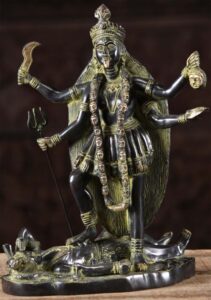
The seventh night is all about Goddess Kalaratri, the most violent and frightful form of Durga. Her name is “the one who is the death of time.” She is the destroyer of ignorance, darkness, and evil spirits. Her appearance may be horrendous, but she is most dearly protective of her devotees. She is connected with the raw energy of transformation. Her intense form is inextricably linked to Goddess Kali, and worshipping her makes an individual transcend all kinds of fear and instill inner strength. The energy of a Kali statue for the altar wonderfully captures this aspect of the divine. You may also request a special Kalaratri idol to keep at home.

kali statues
Explore Goddess Kali Statues

Day 8: Goddess Mahagauri

We worship Goddess Mahagauri, the goddess of peace and innocence, on the eighth day. Her complexion was darkened after she did very heavy penance, but Lord Shiva cleansed her in the Ganga River and her complexion became fair again. She is peaceful, forgiving, and gentle. Her worship cleanses a devotee’s life and makes it beautiful and peaceful. Kanya Puja can be done today when little girls are worshiped as forms of the goddess herself. A serene figure of Mahagauri is a stunning embodiment of such purity.

Day 9: Goddess Siddhidatri

The ninth and last day is for Goddess Siddhidatri, the giver of supernatural power and spiritual wisdom. She is said to bestow all types of success and knowledge upon her followers. She sits on a lotus and holds a mace, discus, conch shell, and lotus in her hands. Her worship on this day brings the spiritual practice of Navaratri to its culmination in the best possible way since she fulfills all desires and grants all wishes. She is the epitome of spiritual practice and devotion. A beautiful Durga idol is generally a center of attraction on this last day, and throughout the year, a Siddhidatri idol can bless your house with flowers.

The Meaning of Navaratri

Navaratri is not merely a ritual festival. It is a tremendous call to action that we have to bridge to our own individual triumph, and it is from spiritual self-control and impartial heart that we derive power. The festival marks passing through the state of sanctity (Durga), to the state of prosperity (Lakshmi), to enlightenment (Saraswati). It is one of joy and uniting as a community in worship. It reminds us that divine feminine is a source of wisdom, power, and creation. That is why having a physical presence, such as a sacred Durga statue, can be such a vital part of one’s daily life.

10 Kali Ma Mantras, Chants, Hymns & Quotes for Pleasing the Dark Goddess

Kali Ma is known as the preserve of Earth, but due to her destructive powers she is also known as “Dark Mother”. The name Kali means She, who is Beyond Time.

To aid her son in his endeavor to rid the three worlds of the multiplying demon, Raktabija, Parvati entered the cosmic battlefield as the dreaded goddess Kali – dark as death, gaunt with sunken eyes, gaping mouth, with long disheveled hair covering her naked body.

She is considered as a berserk form of Durga/Parvati, who is the consort of Lord Shiva. Kali Ma is simultaneously portrayed as the giver and destructor of life. However, in most of the interpretations, she is portrayed as ferocious and evil.

She is the mother of the world and the treasure-house of compassion. She is considered as the primordial mass from which all life arose.


Here are some mantras to please Kali Ma

1. Bija Mantra:

“Kreem”

This mantra will protect you from all the evil forces.


2. Simple form of Kali Mantra:

“Om Krim Kali”

K stands for full knowledge,
R means she is auspicious,
I means she bestows booms, and
M that she gives freedom


3. Kali Mantra:

“Om Kring Kalikaye Namah”

This mantra is simple and transforms the devotee to pure consciousness.


4. Simple Kali Mantra

“Om Sri Maha Kalikayai Namaha”

Only a few people use this mantra due to its purgative nature.


5. Kalika-Yei Mantra

“Om Klim Kalika-Yei Namaha”

This mantra is believed to bring relief from all kinds of problems, no matter how complex it is.


6. The fifteen syllable mantra

“Om Hrim Shreem Klim Adya Kalika Param Eshwari Swaha”

It is believed that this mantra brings rapid growth to one’s spirituality.

7. Kali Mantra for Worship

“Kring Kring Kring Hing Kring Dakshine Kalike
Kring Kring Kring Hring Hring Hung Hung Swaha”

The Mantra consists of three seeds, krim, hum and hrim, and the name ‘dakhshina kalike’ and ‘swaha’, which signifying offering. This mantra is used by the devotees of Kali, the preserver of Earth, who saves us from all the ignorance and the fear of death.


8. Kali Gayatri

“Om Maha Kalyai
Ca Vidmahe Smasana Vasinyai
Ca Dhimahi Tanno Kali Prachodayat”

Meaning: Om Great Goddess Kali, the One and only one, who resides in the Ocean of Life and in the Cremation Grounds that dissolve the world. We focus our energies on you, may you grant us boons and blessings.


9. Kali Chants

a). “Om Kali, Kali! Om Kali, Kali!
Namostute, namostute, namo!
Namostute, namostute, namo!”

b). “Ananda Ma Ananda Ma Kali
Ananda Ma Ananda Ma Kali
Om Kali Ma!”

These are the simple chants to please the Black Goddess.


10. Dakshina Kali Dhyan Mantra : This is also known as karpuradi stotram.

“Om karala-badanam ghoram mukta-kEshim chatur-bhuryam.
kalikam dakshinam dibyam munda-mala bibhushitam
sadya-chinna shira kharga bama-dordha karambujam
abhayam baradan-chaiba dakshina-dardha panikam”

Meaning: Om. Fierce of face, she is dark, with flowing hair and four-armed. Dakshina Kalika divine, adorned with a garland of heads. In Her lotus hands on the left, a severed head and a sword. She bestows sanctuary and blessings with her right hands.


11. Maha kali dhyanam

“Om khargang chakra-gadeshu-chapa-parighan shulang bhushundIng shirah shankhang sanda-dhatIng karistri-nayanAng sarbanga-bhushabritam. nIlashma-dyutimasya pada-dashakang sebe maha kalikang yamastou-chhaite harou kamalajye hantung madhung kaitavam.”

Meaning: Aum, Her ten hands is holding a scimitar, disk, mace, arrows and bow, lance, club, a skull and a conch shell. She is a three-eyed goddess, Her body is covered with ornaments, and Her countenance with the brilliance of blue diamonds, with ten limbs. We offer our service to mahakali, She who Brahma praised for protection from the demons madhu and kaitava, when Bishnu was in sleep.


View all of our Mantras to Hindu Gods
Including English and Sanskrit Translations

10 Kali Mantras15 Saraswati Mantras4 Ganesha Mantras
6 Murugan Mantras8 Krishna Mantras7 Hanuman Mantras
3 Lakshmi Mantras8 Vishnu Mantras5 Shiva Mantras

The Hindu God Nandi, Sacred Bull of Shiva

Nandi, Shiva's white bull
Click to view all our Shiva and Nandi Statues

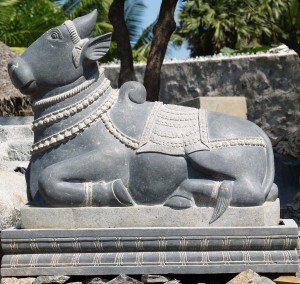
Within Hinduism, Nandi, or sometimes called Nandin, takes on many different roles.  In his most prevalent form he is the sacred steed of Shiva the Hindu god of Destruction, depicted as a powerful white bull.  His white color is marked as a symbol of purity and devotion.  Nandi is said to be Shiva’s main form of transportation and most ardent devotee.  As his most astute follower, Nandi is in charge of leading all of Shiva’s followers.  Along the same lines, Nandi is regarded as the gatekeeper and protector of Shiva as well as Shiva’s consort the Hindu Goddess Parvati.  He can be found in many temples dedicated to Shiva throughout Asia seated and facing the main temple as protector.  His name, Nandi, is even used as metaphor meaning “to stand in the way of”.  It is said that one must first gain the approval of Nandi before being allowed worship of Lord Shiva himself.

Nandi in human form as Nandikeshwara
Click here to view Nandi in human form as Nandikeshwara

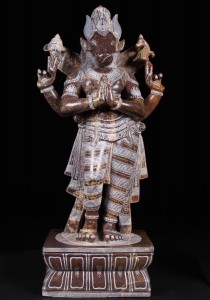
As a primary Hindu God, Nandi is traced in lineage back to ancient dairy farmers that depended on cows for their main livelihood.  As their foremost source of sustenance, Nandi was worshiped as keeper of the herds.  In this form he was said to be bull-faced with a body much like his hallowed Shiva, but with 4 hands.  Two hands holding axe and antelope, and the other two joined in homage.  In this human form he is known as Nandikeshwara.

It is said that many women visit these large Nandi statues outside temples throughout the world and decorate him with flowers and touch his stone in order gain fertility.  Many worshipers who flock to his side also often whisper to in him in order to announce their hopes and dreams hoping Nandi relays their message on to Shiva.

Click here to read more about Shiva the Destroyer