Incorporating Hindu God Statues into Modern Home Decor

Have you ever thought about how to introduce the rich, spiritual tradition of Indian art into a clean-lined, modern home? Our homes are our personal canvas, and in today’s world, we gather objects that reflect our story – a story that is usually a fusion of more than one culture and tradition. Here in this personal curation space, the classic brilliance of Hindu God Statues is making a new home.

These are not just things to be put into a room for looks; they are powerful symbols of deep religious meaning. So how do you create a harmonious dialogue between a centuries old statue and modern decor? It begins with discovering the story and energy each god or goddess brings, and then using key design pieces to bind it together.

Beyond the Ordinary: The Deeper Meaning of Each Deity

Each statue you select reflects a unique element of the universe, and in choosing one, you’re committing an individual act of intention. Let’s discuss the specific energy each god can introduce into your home.

ganesh statue
Ganesh Statue for Home Decor
  • Ganesha Statues: A traditional option and a great starting point with sacred art. Ganesha, with his elephant head, is the remover of obstacles, guardian of intelligence, and lord of beginnings. A Ganesha statue is ideal for a front entrance to bless the visitor, or for an office or home office – a contemporary room – to inspire commitment and success. His presence reminds us daily that any obstacle can be overcome by wisdom and a positive outlook.
  • Shiva Statues: Would you prefer to create a serene space for contemplation and concentration? The last yogi and the supreme deity of transformation, Shiva symbolises inner serenity, profound wisdom, and divine awareness. A meditating statue of Shiva is a great thing to place in a room where one may meditate, a reading nook or even the bedroom. It needs a sense of quietness and separation from the world’s problems. For a consumer looking for a more dynamic energy, the style of Nataraja statues—Shiva as cosmic dancer—is a powerful symbol for the universe’s constant creation and destruction, ideal as a living room or decoration room centrepiece.
  • Vishnu Statues: As the preserver and protector of the world, Vishnu is righteousness, order, and stability. Place a Vishnu statue in a central living area where the relatives and friends gather. He is to bring peace to the family by introducing order and stability. His statue is always shown with him holding a conch, discus, mace, and lotus, symbolising his preservative and protective virtues.
  • Krishna Statues: Krishna is the eighth avatara of Vishnu and the god of love, compassion, and joy. Typically depicted in his form as a mischievous youth, playing the flute, a Krishna statue will bring home the virtue of happiness based on humility and spiritual love. This is an excellent selection for a family, music, and art room where his engaging presence will induce bliss and a sense of upper devotion.
  • Hanuman Statues: Hanuman embodies untainted strength, loyalty, and staunch devotion. He is renowned for possessing  immense power and loyalty towards Lord Rama. His statue is a beautiful representation of strength and willpower. Keeping his statue with you could be an inspiration and a defensive factor, and would make a great addition to a study desk, a gym, or wherever you require the inspiration to drive through personal struggle.
  • Murugan Statues: Youth god, war god, and victory god, or Kartikeya, is the inner consciousness symbol of courage who wears his divine lance (Vel) to overcome ignorance and negativism. A Murugan statue is also a powerful symbol of will and collective endeavor, pushing you beyond inner conflict and struggling with external barriers with a calm mind.
  • Brahma Statues: The universe’s creator, Brahma, symbolises new beginnings, creation, and wisdom. Less popular today in homes, yet a Brahma statue, with four heads symbolising the four Vedas, is a fantastic representation of creativity and wisdom. Brahma is a special feature in a home or office where new concepts are constantly being made.
shiva statue
Shiva Statue for Home Decor

Simple Ways to Bring Harmony to Your Modern Space

The secret to integrating these statues in your home is through deliberate styling. It’s about allowing the statue to stand as a work of art without neglecting its spiritual roots.

  • Contrast as a Design Element: This is an effective method. An incredibly elaborate bronze or brass ganesh statue on a highly plain, streamlined console table creates great visual contrast. The extremely elaborate, ancient form of the statue stands out even more against the plain, contemporary background. This contrast makes the statue and the rest of the furniture stand out more.
  • Playing with Size and Texture: Think about the size of your space. In a large room, a large Hindu God Statue can be used as an anchor piece, while a small, delicate one can be used to create a modern art piece on a shelf. The material’s texture is also an issue: an outdoors weathered stone statue is earthy and organic, while a smooth metallic item is sleek and sophisticated.
  • Lighting and Background: How do you make your statue a focal point? With accent lighting, such as an over-the-table light or a corner table light, highlight the sculptural elements. Position the statue before a dull, bland, plain or dark accent wall to provide contrast.
  • Embrace Outdoor Spaces: The majority of statues, especially those that are crafted from stone or long-lasting bronze, are ideal for patio or Ganesh statues for gardens. They are capable of transforming a simple outdoor area into one peaceful refuge of quiet reflection.
krishna statue
Krishna Statue For Home Decor

A Note on Respectful Decor

When you adorn, be reverent with these statues. Always have them on a raised surface, never on the ground, and have tidiness and a clutter-free space around them. The act in itself honors the object as well as the tradition thereof. One key thing to remember: The northeast direction is the most auspicious for holding deities, since it is the realm of divine energy and water.

A Final Word

As we’ve come to the completion of this guide, you may still be left with some questions regarding the ideal location or what statue you’re prepared for. The truth is that there isn’t a right answer. The sincerest option is the one that resonates with you in your heart and aligns with the energy of your home. Your home is your haven, and in a thoughtful selection of a Hindu God Statue that resonates to you, you can design a home that is not just a place to exist, but a space that resonates with your path, full of beauty, meaning, and spirituality.

Hanuman statue
Hanuman Statue for Decor

The Story Behind Lord Nataraja: The Form of Lord Shiva

dancing shiva- Nataraja

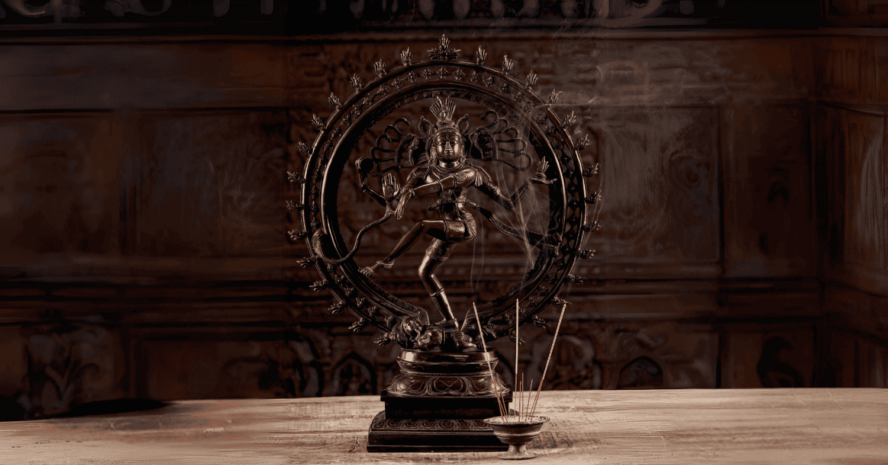
Goddess Parvathi’s consort Lord Shiva is well known in the world of Hinduism and is worshipped in several forms and each form signifies a particular facet of life. Of these, I have selected one of the most graceful and meaningful – Nataraja posturing. The sculpture depicts Nataraja or the “King of Dance”, wherein Shiva in his Cosmic form, represents the cycle of existence, destruction, and recreation, the beat of time and beyond the physical. 
nataraja statues
View Our Dancing Shiva Statues

This article delves into the origins, significance, and deeper symbolism behind Lord Nataraja’s form.

The Origins of Lord Nataraja

However, the depiction of Lord Shiva in dancing posture also has an important cultural and religious value; especially for the southern part of India most associated with Tamil Nadu. The Saivite depiction of dance is called the Dance of Shiva also known as Ananda Tandava, and it has a devoted importance in the Chidambaram temple.

It is significant to note that the concept of Nataraja is stated to have emerged in the course of the Chola dynasty which existed from the 9th to 13th century CE. They now witnessed several bronze sculptures that are mostly focused on the depiction of Shiva.

The Symbolism of the Nataraja Form

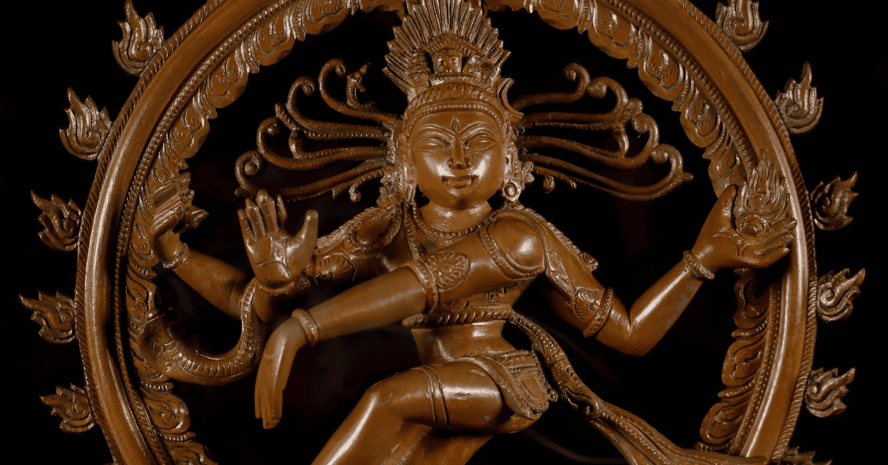
The Nataraja Statue can be considered as one of the greatest achievements both from a spiritual and artistic point of view. Each of the objects depicted in the picture is symbolic of a certain philosophy:

  1. Dancing Posture (Tandava): In the center of the picture there is depicted Shiva dancing within the ring of fire that symbolizes the life-death-rebirth process.
  2. Four Arms: Each of his four arms relates to a different cosmic function:
  • The right upper hand holds a drum (damaru) which denotes the creation and the sound of the universe.
  • The upper left hand has fire or agni which symbolizes destruction or change.
  • In the right hand which is in the lower position, she holds abhaya mudra (protective gesture) and blesses devotees to emerge out of fear.
  • One of the gestures of the legs is pointed downward with his left hand to the raised foot to symbolize freedom and grace from the God almighty.
  1. Dwarf Demon (Apasmara): Covering the feet of Shiva stands a dwarf demon known as Apasmara representing ignorance and ego under Shiva’s feet to represent wisdom.
  2. Crescent Moon and the Ganges: This crescent moon symbolizes time and is included in his hair, and the water that constantly gushes from his hair symbolizes the renewal and purification of the river Ganges.
  3. Encircling Flame: In Encircling Flame or Prabhamandala, the circle around Nataraja represents the other half of the cosmic energy that advices and destroys the universe.
  4. SerenePose: Non-volatile movement – Even though Shiva is dancing vigorously, his facial expression is of peace depicting the dynamic aspect of stillness.

The Cosmic Dance: Ananda Tandava and Rudra Tandava

There are generally two broad categories of Shiva’s dance.

  • Ananda Tandava (Dance of Bliss): This form is the dance that symbolizes the bliss that is created in the universe due to the energy of Shiva.

That is why, for example, there is 

  • Rudra Tandava: The dance of destruction that prepares the ground for creation, a new beginning, and a new life.
nataraja statues
View our brass & bronze Nataraja Statues

Nataraja in Spiritual and Scientific Context

Jain’s research highlights that the Nataraja form of Lord Shiva has been a significant topic in discussions across religion, science, and philosophy. Physicists draw parallels between Shiva’s cosmic dance and the kinetic motion of subatomic particles. This cultural association is further exemplified at CERN (the European Organization for Nuclear Research), where a statue of Nataraja serves as a symbol of this connection.

Worship and Cultural Influence

There’s one more element of the picture that is obligatory for devotees across India and maybe across the world which is Lord Nataraja or the dancing Shiva which has its connection with Chidambaram, the cosmic dance hall. His dance is an integral feature of the temple and its music and dance programs such as Natyanjali in tune with his persona. 

In addition, through a well-executed Nataraja, it is also possible to see how this motif was adopted in classical Indian dance such as the Bharatnatyam in which the dancer translates Shiva’s rhythm across the cosmos into the dance movements.
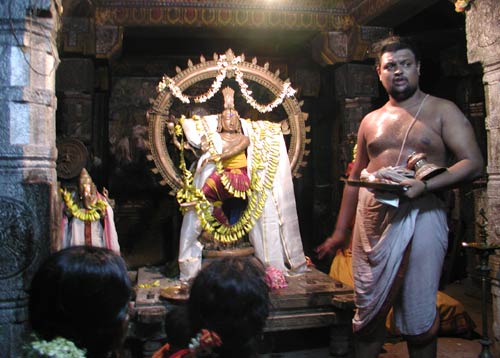
nataraja puja worship
Click to View Our Nataraja Statues

Nataraja’s form of Lord Shiva is not only a beautifully depicted sculpture but holds the cosmic aspect of the universe as well. It also reflects the creative and destructive forces, the light and darkness, the movements and non-movement. Thus, one can learn about the existence of the principles that are timeless when observing Nataraja’s dance, so this form of Shiva is considered one of the most sacred in Hinduism.

Explore the divine artistry of Nataraja and other sacred Hindu Gods idols at Lotus Sculpture, where tradition meets craftsmanship in every masterpiece.
Avatar of Shiva: Virabhadra the Ferocious

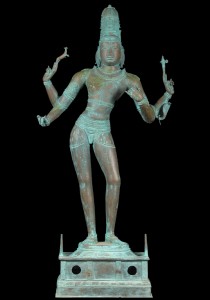
Like many of the Hindu deities, Hindu God Shiva is said to have many Avatars.  One such Avatar is that of Virabhadra.  Virabhadra is said to have been born when Shiva grabbed a lock of his own hair and threw it upon the ground.  He was a powerful being created by Shivas wrath when we wanted to destroy Dakshas Yagna, or fire sacrifice.

View All Our Hindu God Shiva Statues

Legend has it that Dashkas youngest daughter Sati set her sights on Shiva at a young age.  When she was at an age to marry, Dashka invited all the gods and princes together to find a suttor for her, leaving out Shiva.  Furious that he did not invite the one she loved, Sati threw her wreath into the air calling upon Shiva.  Shiva appeared with the wreath around his neck, forcing Dashka to allow her to marry her.  Disapproving of the match however, Dashka again omitted Shivas attendance to a great fire sacrifice.  Sati, out of fury, confronted her father.  She condemned his actions and fell dead at her father’s feet.

When Shiva heard of this, he became enraged.  Out of anger, her tore out a lock of his hair that with glowing with his furious energy.  At this moment Virabhadra was born. His tall menacing body had a thousand arms, 3 burning eyes, and fiery hair.  He was draped in skulls and carried unfathomable weapon.  Shiva instructed him to destroy the fire sacrifice of Daksha and sever Daksha’s head.  Vuraghadra is a said to be a tremendous warrior causing other gods to flee the battle field whenever he appears.  No gods are a match to his fury and strength in battle.

To Learn More About the Hindu Gods CLICK HERE

Shiva as Bhairava: Annihilator of Evil

View all our Hindu God Shiva Statues

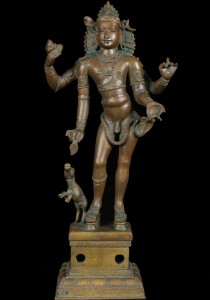
Hindu God Shiva, The Destroyer, comes in many forms.   One such important form and his most fear invoking is that of Bhairava, the annihilator of evil.   This fierce form is manifested when demons make themselves present and are in need of destruction.  Shiva in this form is often depicted draped in serpents as jewelry, wrapped bare naked in tiger skin, and decorated in a ritual adornment of human bones riding atop his divine vehicle, a dog named Shvan.  His frightful characteristics as banisher of evil are almost indistinguishable from Hindu Goddess of Death Kali.   He is seen with devastatingly angry eyes, sharp teeth, and carrying a noose, trident, and skull within his hands. In this form he is said to embody the very essence of fear itself, often forcing those who come upon him to confront their most terrifying sources of fear

The origination of Shiva as Bhairava is said to have been by Shiva himself in order to chastise Brahma, the great creator of the Universe.   Legend has it that Brahma lusted after his own daughter and created four heads in order to constantly be able to see her. His desires for his daughter caused her shame and she is said to have ascended to the heavens in escape.  Brahma then created a fifth head and insisted on her letting him live with her.  Upon hearing of this, Shiva used his sword to rid Brahma of his new fifth head.  Seeing this as an act of killing, Shiva was punished to walk the earth as a beggar carrying around the fifth head of Brahma until he was forgiven of his sin, in which case the skull of Brahma would finally fall from his hands.  Many did not recognize Shiva in his naked and violent beggars form as he howled and danced in madness.

Finally one day as Shiva enters the holy city of Varanasi, the skull falls from his blackened hands and he is rid of Brahmas curse.

Worship of Shivalingam: Infinite Cylinder of Auspiciousness

View all our Hindu God Shiva Statues

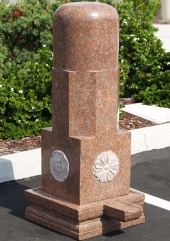
Although Hindu God Shiva is most often depicted in human like form, the worship of Shiva as lingam or linga is also a very important practice within Hindu society.  Shiva is often worshiped in the form of a vertical rounded column.  Within Hinduism linga means symbol while Shiva is thought to be one who is all knowing.  Therefore, Shivalinga stands as a symbol for the great God of the universe who is all-auspicious.

Within the Shivalinga Hindus believe lays all the knowledge of the universe.  Since hindus believe one god creates, sustains, and draws back the universe the Shivalinga is a symbol of God himself.  This symbolism was brought to life in the Vedas where devotees sung praise to a sacrificial post.

View all our beautiful Lingam Statues

This Lingam is used for worship in temples throughout the world.  Many debate whether the lingam is actually a symbol of the actual body of Shiva himself, or simply as a spiritual metaphor for the all-knowing God.  Most Hindus believe it is a source of divine energy, and give offerings to the linga in their temples.  The Lingam is said to be a limitless and endless pillar symbolizing the infinite.